To be able to survive, these migrants have to keep moving. When the war for independence began in 1983, South Sudan had as many as 80,000 elephants; today the figure has plummeted to about 2,000. The sedentary species risk dying. In comparison, the antelope population has remained stable. They are always on the move. Migrants survive because they move out of their comfort zones.

Our cultural traditions have always had a place for a sidekick. Our folk theater has had a jamura who acts as a sidekick to the main performer or madaari. Without the jamura, the madaari’s show is incomplete. From royalty to musicians, there is always place for a sidekick. That may be an opportunity for India as tech becomes Brahma, Vishnu and Shiva in the pantheon of jobs.
It’s useful not just for top management and HR practitioners, but for employees too, as it gives you tips on how to navigate the future office.
Personal power is a barrier to be able to empathize. Today’s leaders need to be rubbing shoulders with their teams, talking to consumers and being accessible in real time. They can no longer stand at the top of the pyramid and survey their empire. Maybe it is time to ask if the cult of the star CEO is still relevant. Read on...
Using a trans-disciplinary lens to solve complex problems will become the norm. Google uses anthropologists to understand how users think and behave. Anthropologists are used to making sense of the full sweep of complex cultures. Google’s coders work with psychologists to understand the emotions that their fonts create among users. Being able to understand others is an integral part of how work will get done. Routine, repetitive work will all get done with machines. So what skills will matter more in future?
When machines start doing our tasks, we hold them to standards that no human can match. We expect them to be perfect. Maybe we know that they are peering over our shoulder and learning to take over our lives. They better be perfect. That is the only way our lives will be perfect. But is it?
When the AI based virtual assistant in our smart phone helps us choose a restaurant or send a text message we enjoy the moment. We don't want to turn the clock back to a time when we did not have AI based systems recommending to us what we never knew we wanted to buy. The machine is watching us and learning each move we make. Instead of augmenting brawn, machines are now augmenting our cognitive abilities. Understanding emotions of self and others will be the next frontier. When people learn to work with machines the possibilities are endless. But is there an invisible price that we forget?
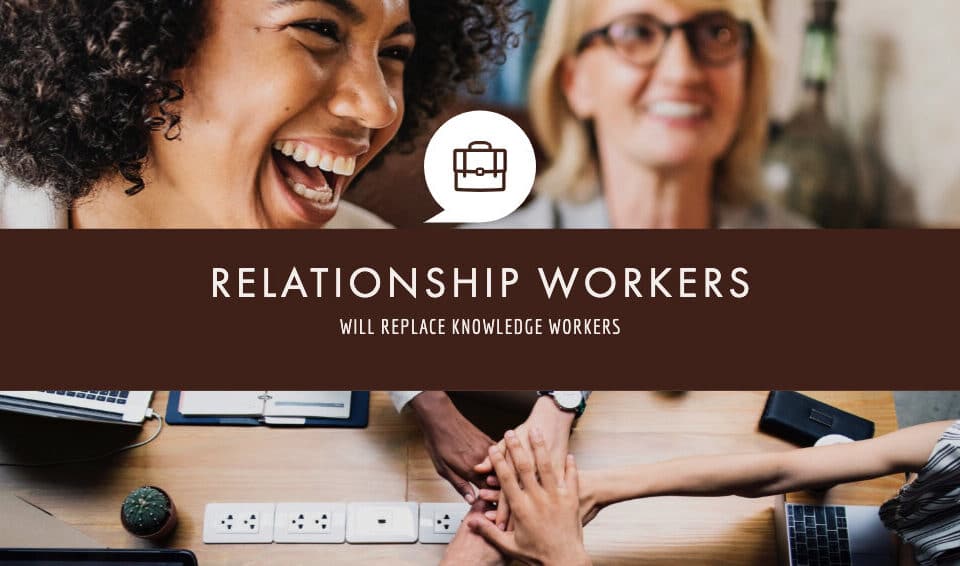
Computers and automation saw the rise of the “knowledge worker”. A knowledge worker was a person whose job involved handling or using information. With computers increasingly taking over such jobs, those who are skilled in working with people will become more prized. The future belongs to people who are more emotionally intelligent. This may be the era of the “relationship worker” – someone who can handle complex human relationships.
Do only the poor work for money? After all, I have seen even the highest paid employees bargain with clenched teeth about an amount that would be less than a percentage of their earning. When someone says, “It is not about the money, it is the principle of the thing that I care about”. You can bet that it is indeed only about the money. Or are we missing the point?