As compared to the drivers on the road, do you rate yourself as better than 90% of them? Most of us would agree with that rating of our skill. We could justify it by saying that, “I am not saying that I am the best driver. But I am better than 90% of the drivers I see on the road.” The problem is that most people tend to believe that too. Statistically speaking that is impossible. Could you succeed as a cabbie? If you said yes, read on.
The response of the environment to failure is an important step. That often determines if the person will continue learning or will smile with embarrassment and stop trying. Having a safe environment is what makes people keep building. Learners are often comfortable laughing at themselves when they fumble. That removes the need for others to do the same. Pain and failure are metrics that tell you that you are learning something new.
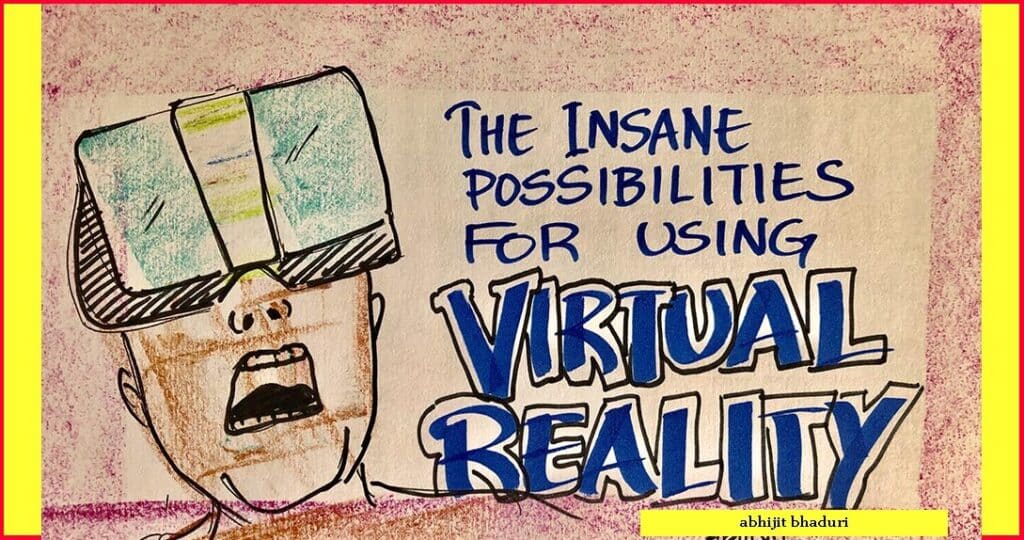
The biggest disruption will be in the Learning & Development space from schools to the workplace. History and Geography taught through VR will allow the student to experience what it feels like to be inside the Pyramid of Giza in Egypt and in the rainforests of Amazon in one afternoon. Imagine the transformative power of bringing this education to a child in a remote village or the slums. How dramatically it could be what education is not.In the corporate world it could be used to simulate the negotiation scenario and teach the team ahead of time what challenges to avoid. If you dread speaking in public, wear the VR headset and practice giving your speech in front of your CEO or even an auditorium full of hecklers (if you are an unpopular politician). VR could help people get over their fears by building their immunity with progressive increases in levels of difficulty.
Every startup wants to grow and big a global corporation. Every global corporation wants to have the spirit of a start-up. Is it harder for a startup to grow or is it tougher for a large organization to be nimble? Both of them have their unique strengths. The giant enterprises have great brand awareness, a stable set of customers and presence across geographies and markets. They also find it easier to hire… maybe they find it easier to hire people who have a lower risk appetite. Who like things that are well defined with clear rules. Once hired these are the very people who will slow down what was once a nimble start up that was hungry and wanted to change the world. What slows down a once fast growing company? The Founders Mentality tells a fat corporation how to lose weight.
Addressing the lower rungs of Maslow’s hierarchy seems passé. Are employees willing to work in a stressful workplace if their mission seems lofty enough? Evidently yes. Recently, Tesla and SpaceX – both run by Elon Musk were in the news for being stressful places to work. Elon Musk responded by saying, “SpaceX and Tesla rated most meaningful work in high tech. Also, most stressful, but that goes with the territory.” Musk has really made engineering and manufacturing interesting again.
Given that the job description of a CEO or someone in a general management role is likely to be fairly similar give or take a few nuances of the business. So why doesn’t every new hire succeed? When a senior executive moves between organizations, what they tend to leave behind is the social capital. They leave behind the teams that they had built strong ties with over the years. They leave behind the goodwill generated in the old company’s ecosystem that gave them more leeway when they faltered. It is no wonder that a new CEO often tends to bring in at least a few key people from the old company.
As robots take on more and more work that is rule bound the opportunities will grow for roles which need empathy, negotiation skills and collaboration, precisely the skills that women are better at because of their caregiving roles. To make that happen we need a reorganization of the workplace so that people aren’t penalized for choosing flexible schedules by being shunted into positions that are less meaningful to them or less rewarding financially. We need to speed up progress by changing the lens with which we view work. It is not about gender any more.
Just as the debate in the previous century was all about an ideological debate between the communist framework or capitalist, the debate for the twenty first century is all about where each country is on that continuum of being open versus closed. It is not a West vs East debate. Many countries in the West are surprisingly close when it comes to data or talent and very conservative when it comes to laws regarding venture capital. People leverage the hyper-connected world to bypass these limitations. Today people are not bound by geography and anyone can use the net to find jobs or learn or show case their talent.
A rating of the employees’ health could legitimately be part of a company's balance sheet. It fits in well with the philosophy of sustainability. Obesity and tobacco usage has been also shown to impact productivity. Knowing that one company has a healthier workforce than its competitors could be a competitive advantage. Investors may also benefit from knowing about the mental health and well-being of a firm’s employees. Occupational health psychologists will point out that stress free employees are less likely to make errors in certain jobs. Does the employer have the right to track the data related to employees' health and wellness?