
Building a skill is easy. Building confidence is harder. Wobbling in a safe space is the key to building confidence, because without it, the skill is useless.
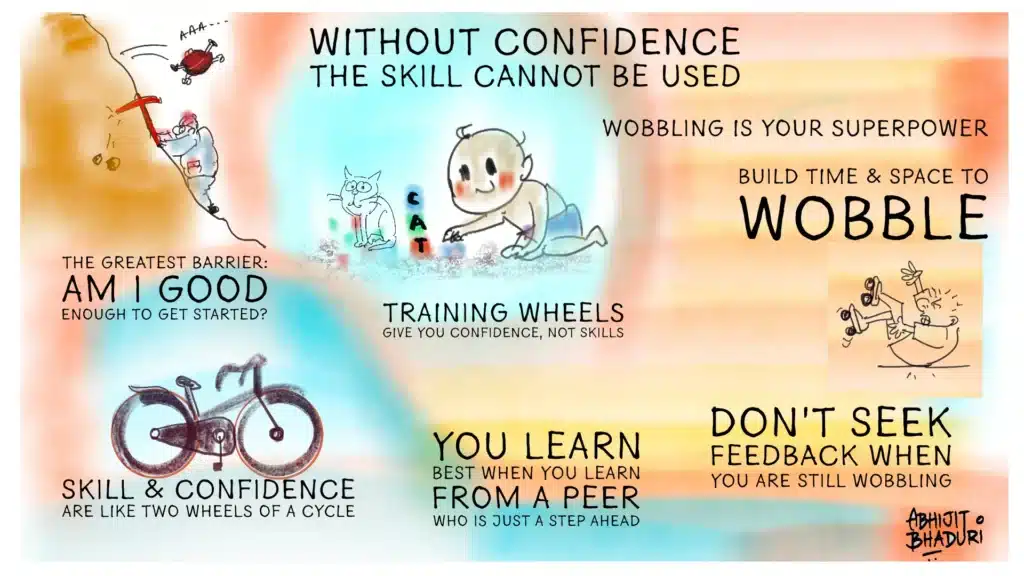

On my fifth birthday I received a bicycle. I did not know how to ride a cycle. My mother noticed my reluctance to try riding the cycle. I had seen my friends wobble and shake as they tried to balance themselves. I did not want to get hurt or feel like a wobbly fool. “There are training wheels. There is no way you will fall.”
Some children in the neighbourhood asked me if they could ride my new cycle. The thought of sharing my new bike with them was unbearable. I refused. After a week of dithering, I mustered up enough courage to give it a shot only to discover that the training wheels were missing from my new cycle. The gangs of my neighbourhood had taken revenge. Without the training wheels I could not ride my cycle. Peace prevailed when I agreed to let them ride the cycle and they in turn would support me as I discovered the superpower called wobbling.
Read more about building this superpower
The foundation of a learning culture is psychological safety — being able to take risks without fear of reprisal. Evidence shows that when teams have psychological safety, they’re more willing to acknowledge their own mistakes and figure out how to prevent them moving forward. They’re also more comfortable raising problems and exploring innovative solutions.
The standard advice for managers on building psychological safety is to model openness and inclusiveness: Ask for feedback on how you can improve, and people will feel it’s safe to take risks.
In the AI era, the “am I good enough?” barrier intensifies as tools rapidly change what “good enough” means. Here’s how to navigate it:
Treat AI as Training Wheels, Not the Destination
Use AI to build confidence while developing core judgment. Let ChatGPT draft your email, but edit it to match your voice and intent. Use Copilot to generate code, but understand what it’s doing. These tools reduce the friction of starting, allowing you to focus on higher-level thinking—the skill that truly matters.
Create Safe Spaces to Wobble
Experiment with AI tools in low-stakes environments first. Use AI to generate ideas for internal documents before client-facing work. Test prompts on personal projects before professional ones. This wobbling phase is where you learn what AI does well and where human judgment remains irreplaceable.
Learn from Peers One Step Ahead
Find colleagues slightly ahead in AI adoption. Their recent struggles make them better teachers than experts who’ve forgotten what confusion feels like. Join communities where people share prompt strategies and failures openly.
Delay Perfection
Don’t seek validation on AI-assisted work while you’re still figuring out effective collaboration patterns. Build your confidence loop: use AI to start, apply your judgment to refine, observe outcomes, adjust. The skill isn’t using AI—it’s knowing when and how to blend machine efficiency with human discernment.
Updated on January 7-2026: The illustration is part of the keynote I will do at WorkhumanConference on April 29-2026