
In my new book AIdentity, I argue that AI can now do much of the work your job title promises. Then I met a team that shows why your experience matters even more in the age of AI. Here’s how that works.
A question I hear a lot these days: “If AI can do my job, what am I worth?”
I have worked in skill development for three decades. Most of us were hired against a job description of a role. Your experience lived inside that description. When AI starts doing the work expected of that role it feels threatening.
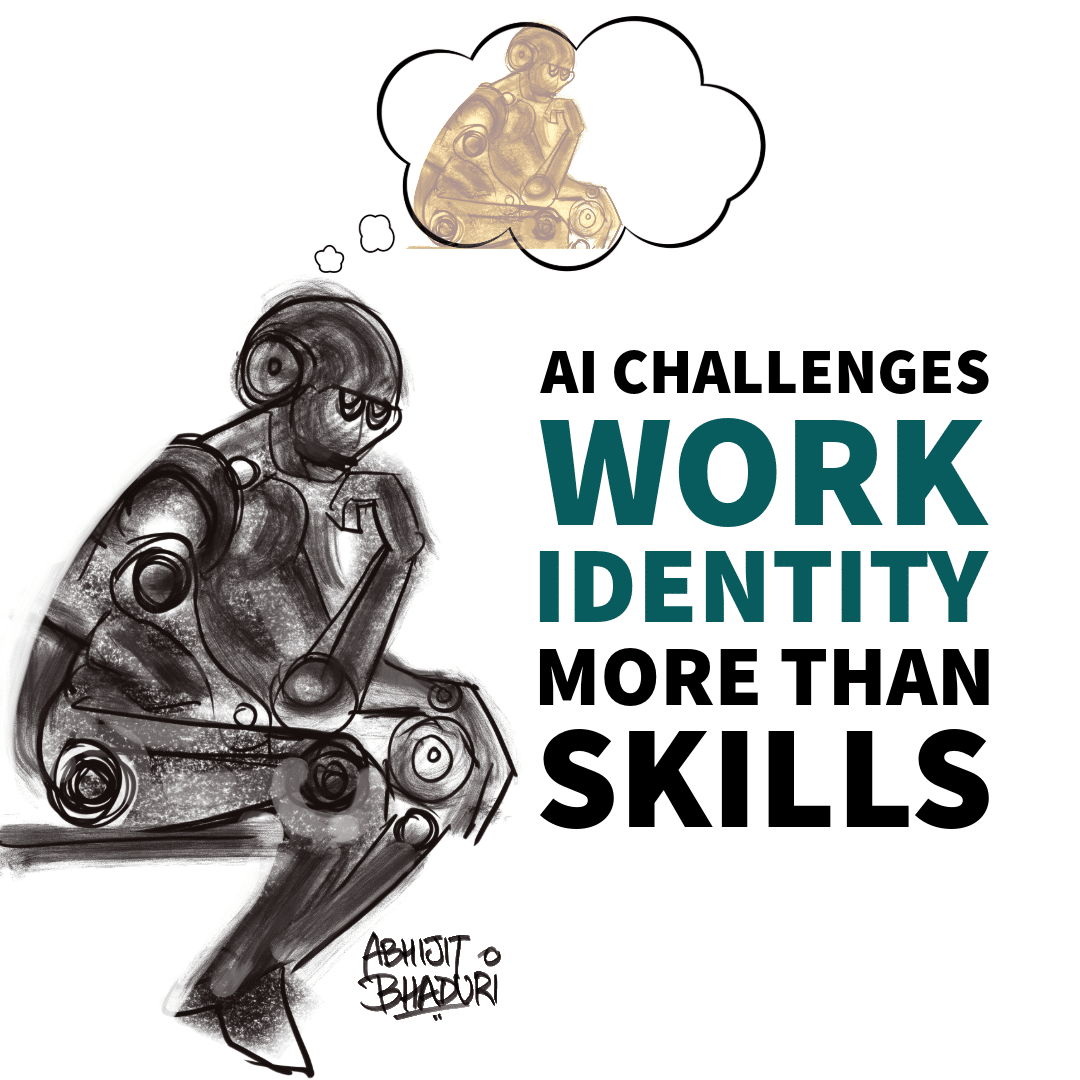
In my book AIdentity, I predicted something different. I said the AI shift would test our work identity more than our skills. The people who do well would let their sense of “who I am at work” grow past the job description. Their experience would matter more, because AI would let them use it in more places.
Then I got to watch that prediction come true.
Four People, No Job Descriptions
For the last 18 months, I have worked with Cyndie Shaffstall and her multi-generational team at Trust Moments. They are building an AI-powered platform that helps real estate professionals grow relationships and referrals.
The team spans multiple-generations. Nobody in this team is a trained software developer. There is no AI engineer on the payroll. A few years ago, that would have ended the story before it began.
Instead, they started with what they had – lots of experience.
Cyndie brought decades in operations. She had learned how to spot bad customer experience, messy data or a shaky process long before it breaks. Jessica knew what research and content standards meant, so she could tell when AI got something wrong. Malala could tell whether a screen felt easy to use because she had experience doing it before AI changed her work. Jack had deep experience that taught him how customers move, which words land and what makes people engage.
The team used their experience to decide what was worth building. Humans scoped, governed, tested, made product decisions, diagnosed failures, changed architecture, and decided when AI should not be used. AI assisted substantially with implementation.
Notice that they did not need to abandon their existing professional identities to contribute outside them. Their judgment simply taught them to reach places conventional job descriptions do not allow. They made mistakes too – plenty of them. They automated a few things that needed a human touch and had to go back to rebuild parts. Their experience is what helped them spot those mistakes and fix them.
They learn, teach, experiment and build without worrying about functional or department silos and narrow job descriptions. This was truly job crafting on steroids.
A Free Copy for You
I wrote the foreword for an ebook because it seemed like a documented real-world example, a controlled study proving how AI will affect work identity, and what will make a team thrive. There are four stages of how work needs to be done in the AI era.
I watched Trust Moments move through four stages from Sensing to Framing and then to Experimentation before Integration, which is the final stage.
If this idea speaks to you, I have a gift.
You can download Case study: How we built an AI-powered relationship and referral engine (and the things I wish I knew then) ebook for free with a Kindle Unlimited subscription.