
You think the failed hire has a culture fit problem when the star salesperson is promoted to be a people manager and fails. But that’s not it, it is actually a failure of identity design. AI is dissolving the work identity, and we need to help the employees to design it around five pillars.
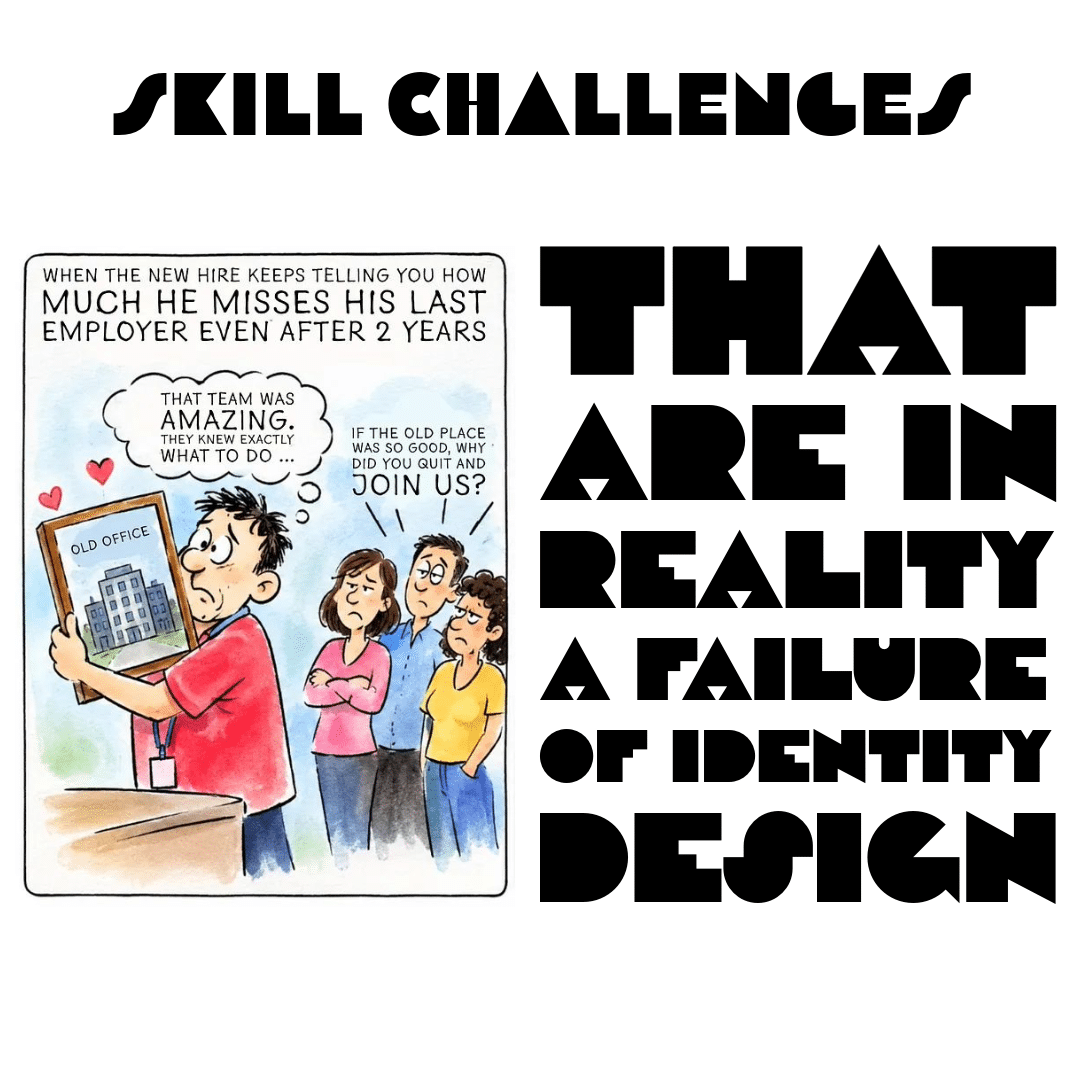
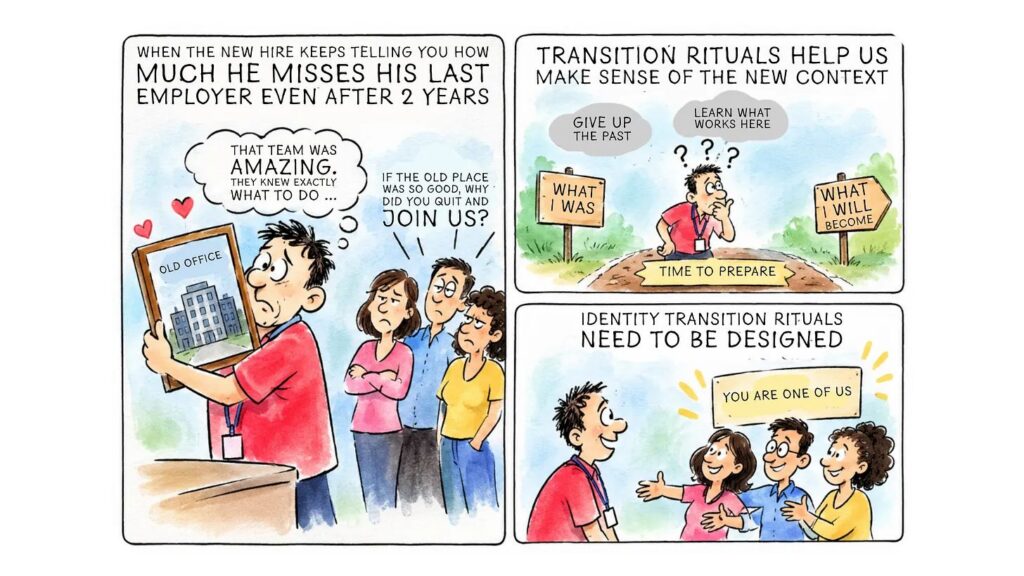
We have seen new hires who forever seemed to mourn their previous employer. They want to rehire their old team, tell you about how life was so amazing with their former employer, and they are oblivious to how much their current team doesn’t like this behavior. In fact, they groan every time he starts a sentence with “My old employer would …”
It is particularly worrisome when after months of being in the new role the person continues to find everything wrong with the current organization.
Chances are that the onboarding team did not do a great job of designing the transition do his new work identity. Chances are that he was not ceremonially incorporated into the tribe.
Early 20th Century Belgian-French ethnographer and folklorist, Arnold van Gennep’s three-phase transition model describes what the new employer skipped: separation (acknowledging who he was), liminality (guiding him through the in-between), and incorporation (formally welcoming him into the new tribe). All three were skipped. The new hire still has an identity in the previous tribe where he was valued. He’s clinging to it because he hasn’t been given permission to leave it and join yours.
This new hire keeps behaving like a guest because that’s where his identity is anchored. While it seems he’s the wrong hire, that’s actually not it. The issue is that no one built in a transition phase for the new hire to learn how the new employer is different and how to leave the past behind. Nobody made the ritual of incorporation.
Was it a hiring mistake?
How many of us have lived this story:
We were all thrilled when the new leader of the function joined us. We had wooed him long and hard. The first few months were slightly underwhelming. He was always waiting for his manager to give him the go-ahead. Execution was slow and we were getting complaints from our customers. We wondered if our hiring process was robust enough because this new hire looked better on paper than in practice.
When a new hire fumbles in a new setting, it is often a signal that they are stuck in the in-between phase
They’re stuck in the disorienting middle of van Gennep’s model. He calls it the liminal space where the old identity is obsolete and the new identity has not yet solidified. They’ve been separated from their old organization and no longer belong there.
Yet, to fully belong in the new environment, their new identity needs to be incorporated. This in-between space activates a threat response in the brain.
When we are threatened, the part of our brain known as the amygdala lights up and the prefrontal cortex, which helps us decide and move, gets considerably weakened. In other words, we get stuck.
So this new hire is not playing it safe because they lack courage. They’re playing it safe because their brain is in survival mode.
They don’t know if they’re allowed to make bold moves because nobody has formally brought them into the culture. Nobody has said, “You belong here. Here’s your authority. Use it.”
The ritual of incorporation never happened. Putting this executive on a performance improvement plan will not fix this. What they need is a ritual that tells their brain that they are in a safe zone where they are one of the tribe. They need to know, “You’re no longer the outsider. You’re one of us now.”
The failed first-time manager
I saw a top salesperson at a consumer goods company get promoted to lead a team, and it went badly. The company lost a great seller and gained a struggling manager. Engagement scores dropped and former peers started complaining about him.
Leadership assumed the problem was a skills gap, so the answer was more training. Overnight, he lost the status of being a star performer. His hard-won expertise, the thing that made him valuable, now worked against him, because managers were supposed to step back from selling themselves. Peers complained about his micromanaging. They said he did not trust the team.
I wanted to catch up with him to understand what was going wrong. He told me that he should have quit when the going was good and not fallen for the glitter of a bigger role. He told me that he had lost all confidence in himself. It was heartbreaking to see him so shaken up.
The problem was that we had not helped him manage the transition from being an individual contributor to leading a team. He did not know how to transition into the new role. He felt threatened.
And, when we feel uncertain, we do not do something new, we fall back on what we are comfortable doing. So, this first-time manager continued to do the role as he always had by doing the selling himself and hovering over the team.
A training course wouldn’t have solved for a transition problem. What would have helped would have been a structured experience with the new tribe he had been invited to join – a cohort of new managers going through the same change together. He needed to hear his peers cheer him on to his new assignment. His new boss could have reassured him that being a beginner is normal. Given that kind of stability, his judgment would likely have recovered within weeks. He would have been ready to learn his new role.
Why the missing rungs matter
Companies like Uber, Intel, and Coinbase are cutting middle management roles. AI can automate routine coordination and answer employees’ questions, but managers also build morale, resolve conflicts, translate strategy, and develop talent. The deeper issue is identity: removing managerial roles also removes status, belonging, and expertise building opportunity at work. When these transitions are compressed, something snaps.
Average manager tenure is 18 months. People move roles faster than ever. AI is automating expertise. Remote work makes belonging harder to build. Gig workers cycle in and out. The old assumption to “let them figure it out over a year” doesn’t work anymore.
Robes, knives and left seats
Think about your college graduation ceremony. You walked across a stage wearing a mortarboard hat with a sash. The crowd cheered and took pictures as you received the piece of paper that gave you respectability in the world of work. Your professors and friends and family were there to witness this moment. By the end of the day, you were a different kind of person.
Nothing about your knowledge changed that day. What changed was your standing. You were no longer a student, and the world now treated you as something else. That shift didn’t happen because a diploma was handed over. It happened because a ritual marked it, in front of people who recognized it.
That’s the core idea I want to build on, and it comes from the Belgian-French folklorist Arnold van Gennep. In his 1909 book, The Rites of Passage, he noticed that almost every society marks major life changes in the same three-part pattern. First comes separation, where a person is detached from their old role or group. Then comes a liminal phase, a threshold period where they belong to neither the old world nor the new one. Last comes incorporation, where they are formally welcomed into their new identity. Van Gennep’s insight was that the middle stage, the liminal one, is where the real transformation happens, and it’s the stage that most modern institutions skip entirely.
Once you see the pattern of a transition ritual, you find it everywhere. Religions mark the move from child to adult through confirmation, the sacred thread ceremony, bar and bat mitzvahs, followed by community recognition. Medicine uses the white coat ceremony and taking the Hippocratic oath, and then a residency that serves as a long liminal period before a doctor is fully trusted.
Many kitchens have knives that apprentices borrow or share for years. Being allowed to buy or receive a personal knife marks that you’ve moved from helper to cook. The apprentice spends time at the prep station to learn to peel, chop and stage the food. This is followed by a long apprenticeship, and incorporation is the knife you can call your own.
Military forces send recruits through basic training where they are stripped of civilian habits, and then present them with the uniform and the rank. Pilots log solo flights and receive wings only after a period of supervised flying. There is a formal ceremony when a pilot is first allowed to be in the “left seat”. It is not the skill that changes. It is the transition to the membership of a new tribe. Each profession has learned that a title alone doesn’t make someone a member of the tribe. That is a time when the person is allowed to be a beginner to fathom the new context.
Design transitions as AI changes every role
In a world where AI is reshaping work, this gap matters more than ever.
When work changes faster than role definitions, people lose their work identity. Organizations often respond by adding new tools and new skills, but they rarely think about designing the transitions that help people make sense of what those changes mean for them. It is a very different world of work, workforce, and workplaces.
AI is changing what work means. Ownership and authorship are becoming blurred. When an AI system drafts the analysis, writes the code, or generates the design, people struggle to say what is theirs. Pride in a finished product depends on a sense of authorship, and when that sense weakens, so does motivation. Organizations that move people into new roles without addressing this shift leave them unsure what they are now responsible for and how performance is evaluated.
The workforce is changing too. As AI agents take on more routine tasks, many teams will have fewer people doing more coordinated work. That makes belonging more important, not less. When there are fewer colleagues, each relationship carries more weight. A transition that moves someone into a smaller, more interdependent team without deliberate effort to build trust can leave them isolated, even in a busy office.
Workplace norms are shifting as well. Expertise used to be measured by what a person could produce alone. Now much of the valuable work happens alongside AI, and nobody has settled how that should be judged. Status that once came from being the best individual contributor may not carry over, and people who are good at directing AI may not yet be recognized for it. Without clear norms, people guess at the rules, and guessing under pressure is exhausting.
This is why transitions deserve deliberate design. Separation honors what people are leaving behind. A threshold period gives them room to learn the new norms without fear of looking incompetent. Incorporation confirms who they are becoming, in front of the people who will work with them.
Stability is often treated as the opposite of change, but it may be what makes innovation possible. People who feel secure in their identity are more willing to experiment, admit uncertainty, and share half-formed ideas. In an unpredictable world, that willingness may be the most durable competitive advantage an organization has.
First written for Leader to Leader insights dt Nov 5-2026 <read it here>