
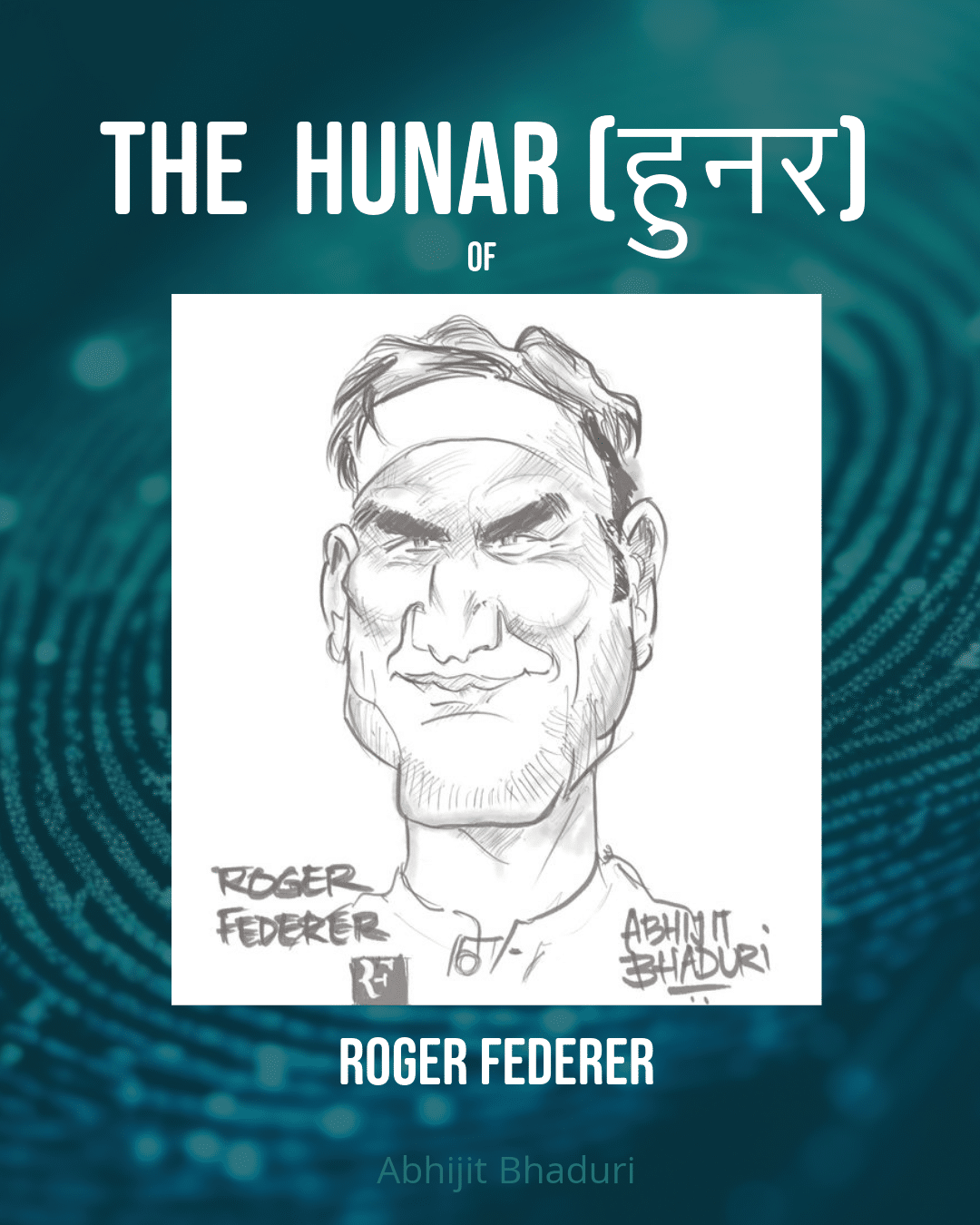
Roger Federer did not just play tennis better than everyone else. He made everyone else feel they were playing a different sport.
The Day Pete Sampras Knew
In 2001, Pete Sampras was the greatest tennis player alive. Seven Wimbledon titles. Fourteen Grand Slams. He had seen every opponent imaginable.
Then a nineteen-year-old Swiss kid walked onto Centre Court and beat him.
Sampras did not just lose. He said afterward that Federer moved differently from anyone he had ever faced. Not faster. Not stronger. Something harder to name.
That something is Hunar.
Skill Gets You to Wimbledon, Hunar Wins It
Every player on the ATP Tour is extraordinarily skilled. They have all hit a million forehands. They all know where to serve on a big point. They all watch hours of footage on their opponents.
Rafael Nadal had the most ferocious topspin forehand the game had ever seen. Novak Djokovic had the most complete defensive game in history. Andy Murray could retrieve balls that had no business coming back over the net.
These are skills. Learned, trained, measured, repeated.
Federer had all of those too. He had to. You cannot win twenty Grand Slams on charm alone.
But then there was the other thing. He seemed to arrive at the ball before he had started moving toward it. Andre Agassi, one of the greatest returners in the history of the sport, said that Federer’s serve was the hardest to read he had ever faced because the body gave away nothing. No tell. No signal. The ball simply went somewhere unexpected, every time.
That is not a skill you can copy. That is Hunar.
What His Rivals Said When He Left
When Federer retired in September 2022, he played his final match at the Laver Cup in London alongside his greatest rival.
Afterward, Nadal sat in his chair and wept. Openly. Without embarrassment.
Think about that for a moment. Nadal beat Federer in some of the most brutal matches in tennis history. The 2008 Wimbledon final. The 2009 Australian Open. He had every professional reason to feel neutral about a competitor leaving the sport.
But he wept.
You do not weep for someone’s skill. Skill retires every day. Players hang up their rackets, the rankings shuffle, and someone else takes the top spot.
You weep for Hunar. Because Hunar belongs to one person and when that person leaves, it is gone. Completely and permanently gone. No successor. No replacement. No version two.
The Lesson for the Rest of Us
Federer started with skill. He was talented, yes. But so were dozens of players who never won a single Grand Slam.
What made him irreplaceable was the long, patient work of becoming fully himself on a tennis court. The grace was not a style choice. It was the expression of who he was. He brought his whole self to the game, and the game became something it had never quite been before.
That is available to all of us. Not the twenty Grand Slams. But the work of finding the thing that only you do, in the way that only you do it, until the people around you cannot imagine that work belonging to anyone else.
AI can teach you techniques of Federer. It can never teach you what makes Federer’s opponents cry. That is Hunar.
Discover your Hunar.