
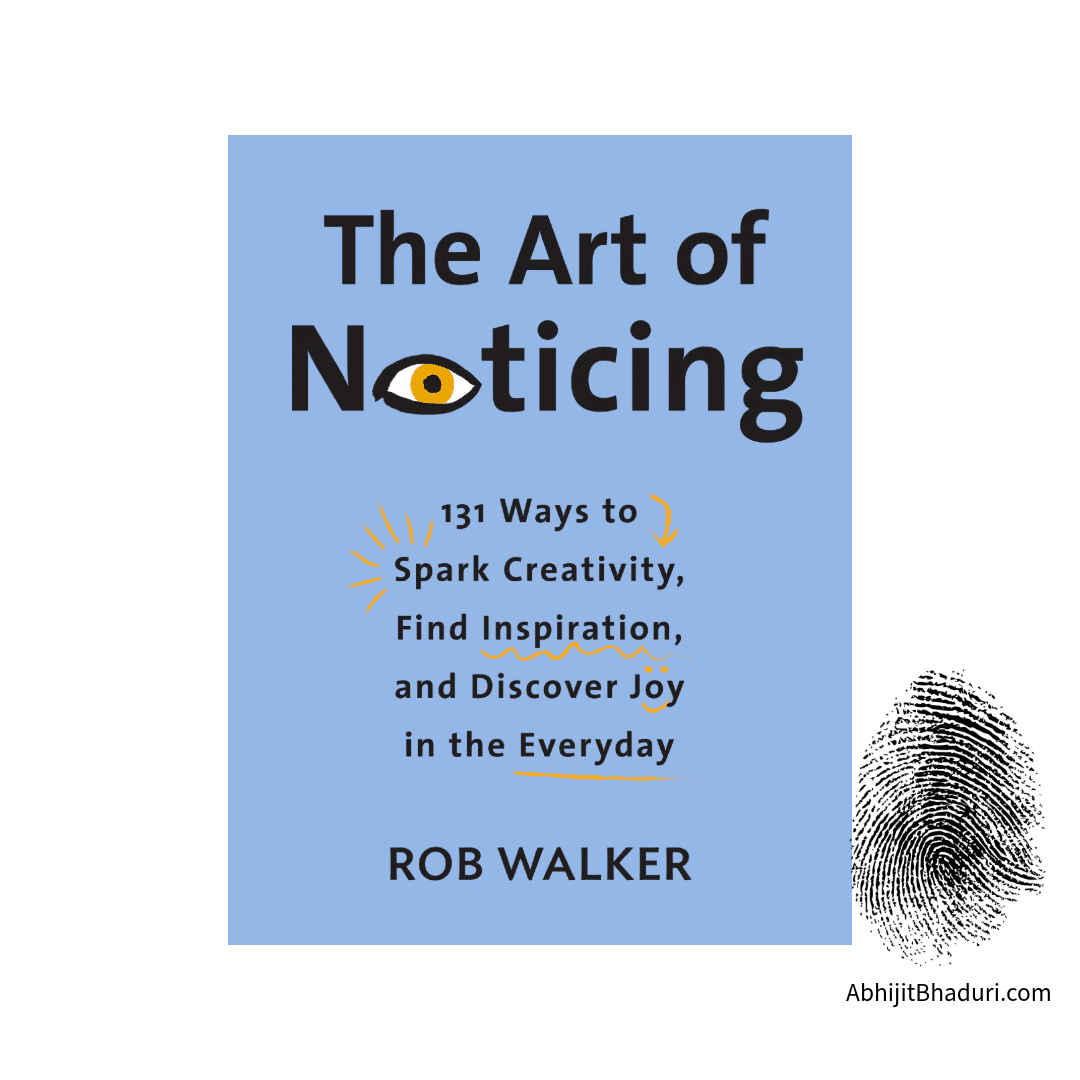
Imagine a love letter to the lost skill of paying attention. That is this book complete with 131 bite-sized exercises that wake you up to a world you see but don’t notice. The Art of Noticing by Rob Walker is an invitation for anyone who has ever looked at their phone instead of the sky.
You can observe a lot by just watching
There is a psychological phenomenon called inattentional blindness. In this experiment an actor poses as a lost tourist to ask someone for directions. People did not even notice that they are talking to two different people. Most do not notice the switch. Did you? I bet you did. Let me know in the comments.
Without looking back to see the photo of this article, can you draw the cover image of this article? Yes, a black and white pencil scribble will do. Compare it to the cover photo, ask what you missed noticing.
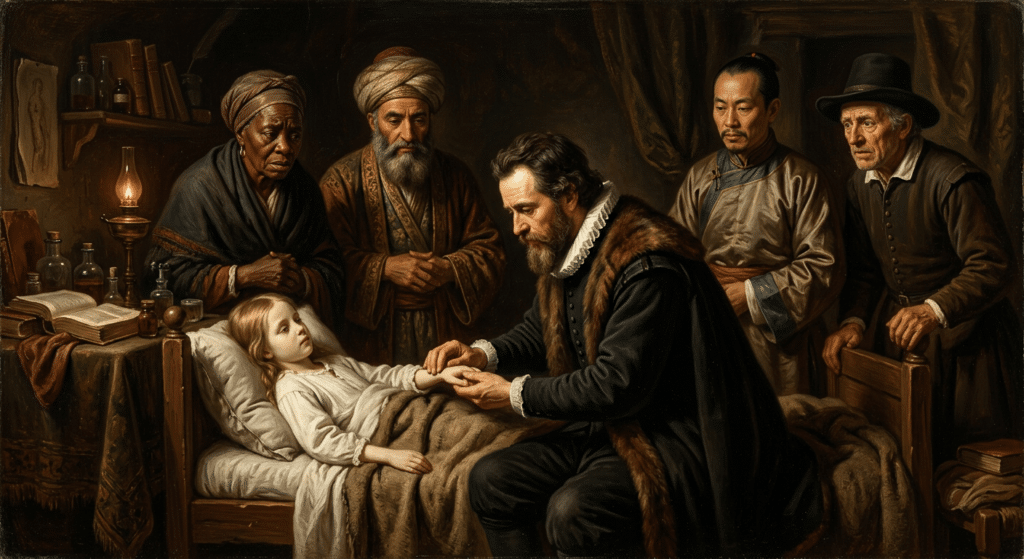
Metropolitan Museum of Art found that visitors spend a median of 17 seconds in front of any given painting. Seventeen seconds. In front of a Rembrandt. Seventeen seconds, and then they move on . They want to take a selfie with something they haven’t actually looked at. Spend 17 seconds looking at this picture and ask a friend to ask you details about the painting. For example: How many books did you count in the painting?
Rob Walker gives you 131 exercises that are ranked from “So Easy” to “Advanced” and are essentially ways to build your skill of noticing. It is organized into five chapters — Looking, Sensing, Going Places, Connecting with Others, and Being Alone. You can read from beginning to end, or you can open the book at random and find something worth doing. It reads less like a traditional book and more like a conversation with a very curious friend who keeps saying, “Oh, have you ever tried this?”
Noticing takes time
Some of the exercises are deceptively simple: look up from your phone. Spend ten minutes drawing something instead of photographing it. But others are quietly radical: spend three hours looking at a single painting (Harvard art history professor Jennifer L. Roberts does this with her students, and what they discover consistently transforms their understanding of the work).
One of the most counter-intuitive and psychologically fascinating ideas in the book is what Walker calls the “conditional thinking” exercise, drawn from the work of psychologist Adam Grant. In an experiment, one group was told “This is a rubber band.” Another group was told “This could be a rubber band.” When asked to use the rubber band to erase a pencil mark, 40% of the “could be” group figured it out. Only 3% of the “is” group did. Shifting from fixed to conditional thinking — from “what is” to “what could be” — does not just change your mindset. It quadruples your creative capacity.
Then there is the story of Davy Rothbart, who as a boy made a habit of picking up random notes blowing around a ball field. One night he found a note on his windshield — addressed to someone named Mario, furious and heartbroken. He showed it to friends, and discovered everyone had similar treasures — notes, drawings, photos — stuck to their refrigerators. He launched Found magazine, a collection of discarded papers found in the world, which became books, film projects, and an online community. His entire creative career grew out of learning not to walk past things.
EXERCISE: Just go back to that painting and spend 2 minutes (use a stopwatch) looking at the people and the room where they are. What did you notice that you had missed. Try to answer some questions:
1. Describe the people standing in the room (Hope you did not count the doctor or the child)
2. How many people are wearing some headgear?
You become what you notice
When you deliberately choose what to look for (the concept of a “mental search image”, borrowed from ornithologist Luuk Tinbergen), you rewire your brain to find that thing. Walker started looking for security cameras in San Francisco, and now, years later, sees surveillance cameras wherever he goes. You become what you repeatedly notice.
Ellen Langer, Harvard psychologist and mindfulness pioneer, says it best in a quote Walker includes: “When you actively notice new things, that puts you in the present. As you’re noticing new things, it’s engaging, and it turns out… it’s literally, not just figuratively, enlivening.”
Walker describes the book as “an escape from the cult of productivity and efficiency.” This is what makes it different from other creativity books. He is not asking you to be more productive. He is asking you to be more alive. As he puts it, in the single most powerful line of the book: “Do you want to look back on a life of items crossed off lists drawn up in response to the demands of others? Or do you want to hang on to, and repeat, and remember, the thrill of discovering things on your own?”
What becomes important, you pay attention to. What you pay attention to becomes important.
Noticed about the book
The writing style is worth noting. Walker writes the way a great curator designs an exhibition. He chooses each piece carefully, places it with intention, and then steps back and lets it do the work. His voice is warm, intelligent, and never flamboyant. Every piece of advice is illustrated with a story, an artist, a researcher, or a student. He never tells you what to think about the exercises. He trusts you. This restraint is unusual in self-help writing and makes the book genuinely pleasurable to read.
What you pay attention to becomes important. What becomes important, you pay attention to.
About Rob Walker
Rob Walker is a journalist and design critic who has written for The New York Times, The Atlantic, The New Yorker, and Bloomberg Businessweek. He teaches at the School of Visual Arts’ Products of Design MFA program in New York, and it was from that classroom — where he asked students simply to “practice paying attention” — that this book was born. He lives in New Orleans, a city that seems tailor-made for someone who notices things.
Check out his website https://www.robwalker.net/ noticing