People use AI even to write the comments. AI creates some AI slop for you to copy-paste. Here are 8 ways to use as you read the next post that resonates with you. Don’t just put a like and move on. Acknowledge-Add-Advance is a simple way to remember this
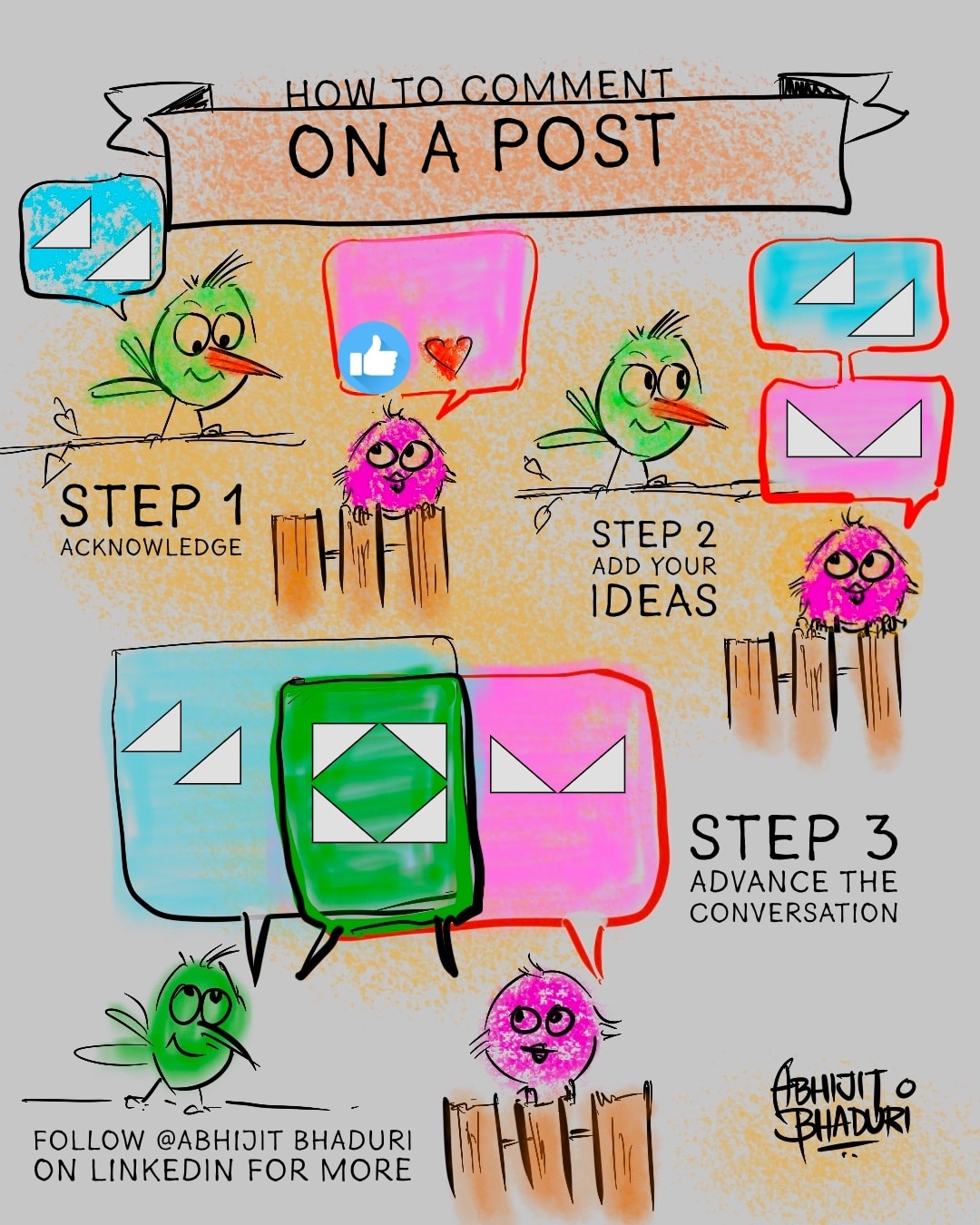
Acknowledge Add and Advance
You read a post, put a like and move on. WAIT…
You just walked away from a terrific opportunity for brand building all because you didn’t do step 2 and step 3. Lets start with step 1.
Step 1: Acknowledge the idea
For starters choose a different icon other than the like button. That is a default setting. 99% people have never used any other emoji. You can go ahead and put the 🩷 or 👍 or 👏 – you can be distinctive even as you put the like button. You can support, celebrate, say the idea is insightful
Step 2: Add your ideas
This is the heart of the idea. I use a variety of these approaches every time I respond to a comment.
- Inject a Metric : If the post says something about Gen. Z then you could share a metric that is relevant which either supports the original post you are commenting on or provides a contrast
- Reframe the Idea: If the original post talked about the creator economy, Talk about how it is leading to the creation of AI slop and that the real creator economy is the niche of people who are original thinkers.
- Apply a Cross-Disciplinary Analogy (The Polymath Pivot): If the original post is talking about workplace fatigue and you are a software engineer, use your disciplined to create a lens with which explain the problem better. You could say, “Your brain is like a computer that needs to opening a new file every time someone interrupts you with a quick message or meeting. Then the brain is forced to close that file, open a new one, and then spend 20 minutes reloading the original file back into memory. By organizing work so people can focus on one task at a time without constant switching, employees stay energized and get high-quality work done much faster.”
- Identify the “Next-Order Consequence” (The Horizon Scan): Treat the author’s main point as a starting assumption, then project its likely impact 3–5 years into the future. If a post discusses the increasing automation of entry-level work, you could write: When organizations automate entry-level tasks, they may unintentionally eliminate the training grounds that prepares their talent pool for middle and senior levels. The task that the junior teams are assigned to do builds their judgment and meaning making ability which is so critical in future roles.
- Share categories: The authors post about workplace fatigue can be built into different categories for example the fatigue that the experience because the work is uninteresting, after all reviewing AI output can be a boring and tedious task. You could also talk about the fatigue that arises from unclear expectations from the role. Order the legacy performance metrics which do not acknowledge the new way of working. That would be structural friction.
- Pick a cohort: When someone writes about AI stealing jobs, you could talk about the trend of Gen. Z in US moving to take up blue collar jobs because they seem to be relatively unimpacted by AI. Sharing a specific cohort’s experience can be powerful.
- Offer a historical precedent: While there may not be an exact historical event that matches the current displacement of jobs pertaining to AI, but if you take a step back and examine the impact of changes in the way work has shifted during say the first and second industrial revolution you might draw some interesting conclusions about how this could play out in the new world of work.
- Share how you could apply the idea: if you have seen such an idea implemented even mentioning that in the comment can be a huge value add to the reader. You could start your comment by saying, “this is what I tried when I worked at X and here is what I learned…”
Step 4: Advance the idea
This is where you give the readers a reason to click your profile. You can also share a story about a related incident. Share a downloadable framework from your website and any book/ podcast or related post that you read recently.
Your own individual point of view will stand apart from the gallons of AI slop that the reader is seeing everywhere. Your own voice and imperfections will add to authenticity. I have sometimes shared a sketchnote that fits the context.