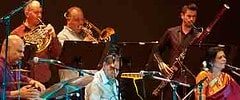
 Take a fistful of ancient folk melodies of Carnatic music and have the KCP4 make a beginning. Now have the musicians of Renga/ London Philharmonic Orchestra play Jazz. What you hear is a delightful blend of Carnatic Jazz which sounds really magical. KCP4 stands for Karnataka College of Percussion that was started by TAS Mani in ’64. The 4 stands for the quartet comprising Ramamani (vocals), Ramesh Shotham (percussion) and TAS Mani on mridangam and Mike Herting on the piano. You can see all of them (except Mike Herting) in the front row of this photo.The concert began with the piece called “Arun”. Ramamani’s powerful vocals make you imagine the look of the sky at the break of dawn. The piano follows her notes almost like a sarangi does in Hindustani Classical. The mridangam and percussion pick up the notes and soon catch up to create a foot stomping piece. The Philharmonic joins in to create a unique sound that is at once immensely melodious and foot-tapping.Hear this introductory video and you can get a flavor of how the concert started.Ramamani had composed most of the pieces that were performed that evening. Most of them follow two different rhythmic cycles allowing for effortless blending of the London Philharmonic Orchestra.
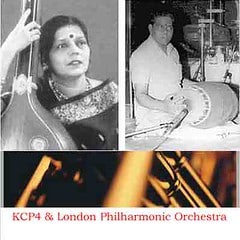 Well, actually this ensemble from LPO is called Renga.It is a group of performers and composers from outside the classical music stream. Their sound has African Jazz, traditional Jazz and folk sounds all of which are played on the violin, viola, cello, double bass, flute, bassoon, trumpet and horn. The evening belonged to Ramamani who delighted us with her complete control over the notes as well as the skilled Konnakkol renditions. Konnakkol is the vocalisation of the Indian percussion’s rhythmic language.I believe they have an album called Many Ways. The title track was the third song they performed that evening. Note to myself: Locate that album quick.If there was one musician in KCP4 who really plays oblivious of the crowd, it was the pianist Mike Herting. He listens to the opening vocals and then peers close to the keys of the piano as if just the way the diamond merchant would look to see that no precious stone from his collection would be missed. He mumbles to himself, he hums the note that he is playing and then with each improvisation, experiences the bliss that comes from playing good music. By the time the song is over, his hair is dishevelled, his specs are foggy and he looks more like a scientist emerging from his lab. But oh what talent… he was just incredible.Can’t wait to hear them again.

1 Comment
Hey this is a nice post…..keep sharing these stuffs