A resume is a collection of signals. The real question is whether those signals help us predict what someone can actually do. AI makes certificates cheaper and easier to collect, the value of a credential increasingly depends on whether it is a genuine gateway to competence or simply another badge in the pile.

The Credential Collection Has Begun
For years, we were rewarded for filling it. Every degree we gathered showed up on the resume. That was the scaffolding for our work identity. We slapped on certifications, leadership programs, and more recently a bunch of courses on AI and then some bootcamp…
The logic was simple: more credentials must mean more capability.That logic is now under pressure.
Generative AI has made learning content dramatically easier to access. A candidate can complete courses, pass assessments and collect certificates at a pace that would have seemed impossible a few years ago. The result is a strange new career arms race.
People are hoarding credentials because they are trying to make themselves easier to recognize in a crowded labor market. But recognition and competence are different things.
Credentials are Signals
A credential is evidence from the past that something happened. It tells us that someone once had completed a course, passed an examination, attended a program or met a professional standard. It does not automatically tell us what that person can do when the problem arrives. In some professions that does matter a lot.
You would not want a hospital to introduce your surgeon and say, “She watched 40 hours of surgery videos and has an impressive LinkedIn profile.”
In the United States, physicians must be licensed to practice. Surgical certification involves formal training, examinations and other requirements. The American College of Surgeons notes that board-certified surgeons have completed approved residency training and passed specialty examinations. Surgical credentialing can also include review of training, experience, case logs and professional history.
Here the credential is part of the safety system. It certifies a minimum acceptable level of proficiency to be trusted to do the job.
Credential Inflation Is Already a Hiring Problem
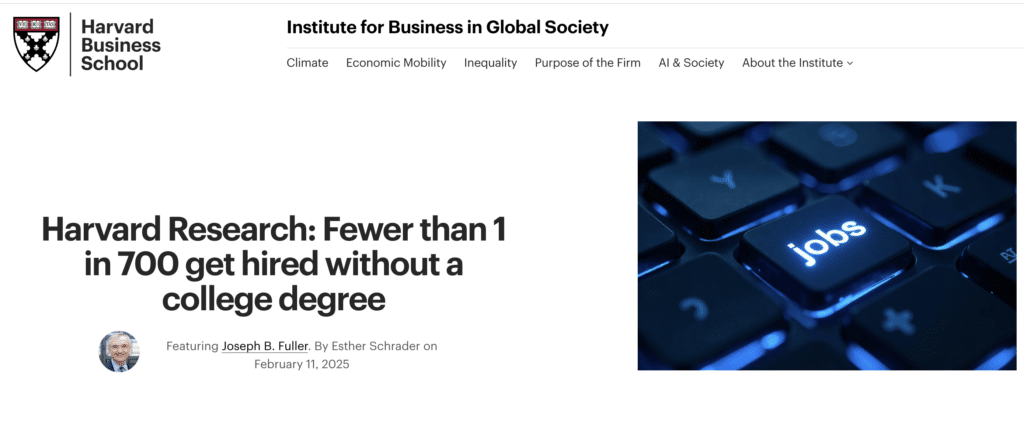
Harvard Business School and the Burning Glass Institute have documented a related phenomenon called degree inflation.
Employers have increasingly asked for four-year degrees for jobs that historically did not require them, even when the underlying work had not materially changed. In one analysis, 67% of production supervisor postings required a college degree while only 16% of people actually working in those roles had one.
The problem is our tendency to use credentials as a shortcut for judging people.
The shortcut is understandable. A recruiter facing 800 applications needs filters. “Has a degree from X” is easier to process than “Can diagnose an ambiguous customer problem, influence five stakeholders and turn the insight into a decision.”
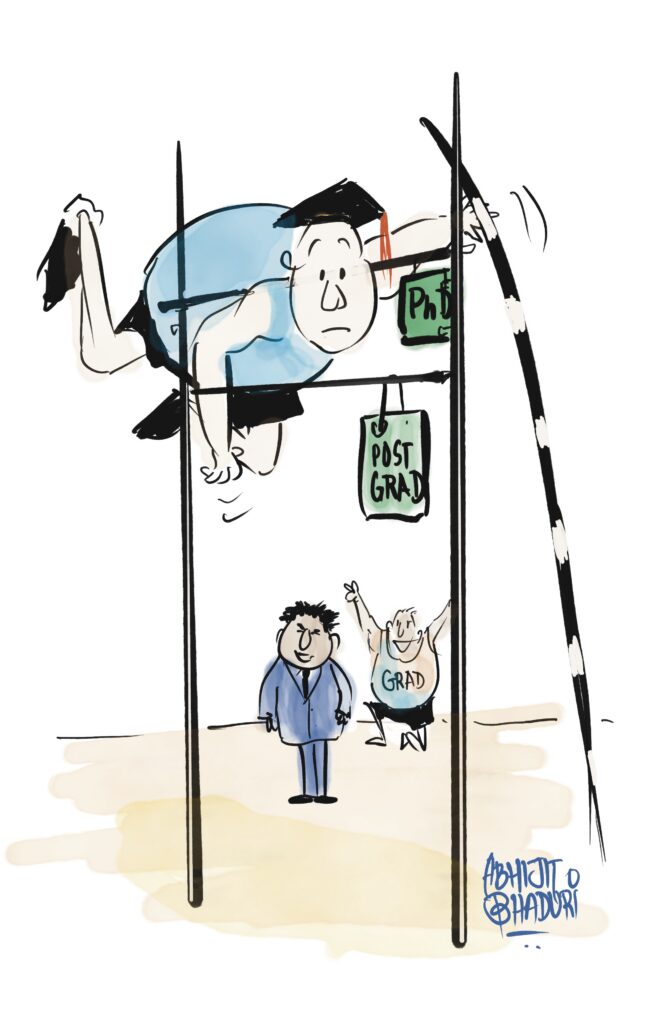
But easy filters can become bad filters. When everyone can acquire certificates faster, the signal becomes noisier. In a room where everyone starts wearing medals, the medal has limited value.
“With everything perfect, we do not ask how it came to be. Instead, we rejoice in the present fact as though it came out of the ground by magic.”
Nietzsche
The Credential Arms Race Has Consequences
The first consequence is credential inflation.
If ten candidates have an AI certificate, the eleventh candidate feels pressure to get one too. Then the certificate becomes expected. Then another, more advanced certificate becomes desirable. Soon, people are spending time collecting evidence of learning rather than demonstrating what they learned.
The second consequence is a new kind of career anxiety.
Everyone wonders which certificate to collect next to create a moat of safety where layoffs are the norm. But knowing what problem you can solve is better but that is a big psychological shift.
The first creates a consumption mindset. The second creates a capability mindset.
If organizations keep adding credentials to job descriptions, candidates respond by optimizing for the hiring system.
People learn how to pass the filter. They become excellent at producing signals. The organization becomes worse at detecting judgement, adaptability, curiosity, problem-solving and the ability to perform under real-world constraints.
While skills-based hiring has gained ground, but the change from removing degree requirements to actually hiring more non-degreed workers has been relatively modest.
How to Test Capability
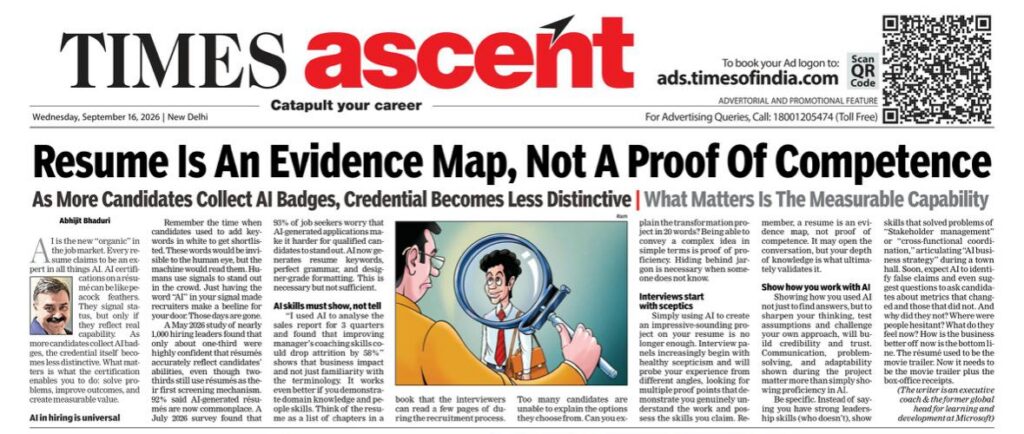
A resume should create enough curiosity to start the conversation. It should not be mistaken for the movie.
1. The Resume is a Trailer – Not the Movie
A resume should create enough curiosity to start the conversation. Ignore the resume that says, “Completed Advanced AI Strategy Certification”. Look for the one that claims “Redesigned our customer-service workflow using AI, reducing average response time by 31%.” Credentials open the door. Evidence of performance is the real deal.
AI is the new “organic” in the job market. Every resume claims to be an expert in all things AI. The valuable person is not listing AI as a signal. It is the person who combines AI skills with business acumen and strong people skills.
2. Do They Know When Not to Trust AI
AI certificates are particularly vulnerable to becoming résumé wallpaper. Ask people to demonstrate how they solved a business problem using AI. Watch how they frame the problem, challenge the output, identify what is missing, make a judgment and explain their decision.
3. Hiring Should Be a “Show Me” Process
This moves hiring closer to an audition. A musician can have a room full of certificates.
You still want to hear them play.
But Credentials Are Not Useless
Credentials establish specialized training and a common standard across institutions. They can signal persistence and foundational knowledge. In professions (like medicine, flying, engineering etc) where mistakes can cause serious harm, society has good reasons to demand formal qualifications.
Where the job is primarily about judgment, creativity, communication, commercial thinking, collaboration or problem-solving, the credential may be only one piece of the evidence.
The future of hiring may not belong to the person with the longest list of certificates. It may belong to the person who can turn learning into useful action.
Read more: https://www.hbs.edu/news/releases/degree-inflation-us-competetiveness