
Talent gives you the ability to be above average with little effort. Skill is learnt, practiced and sharpened with feedback and coaching. Hunar is the difference between a skilled architect and Zaha Hadid’s architecture.
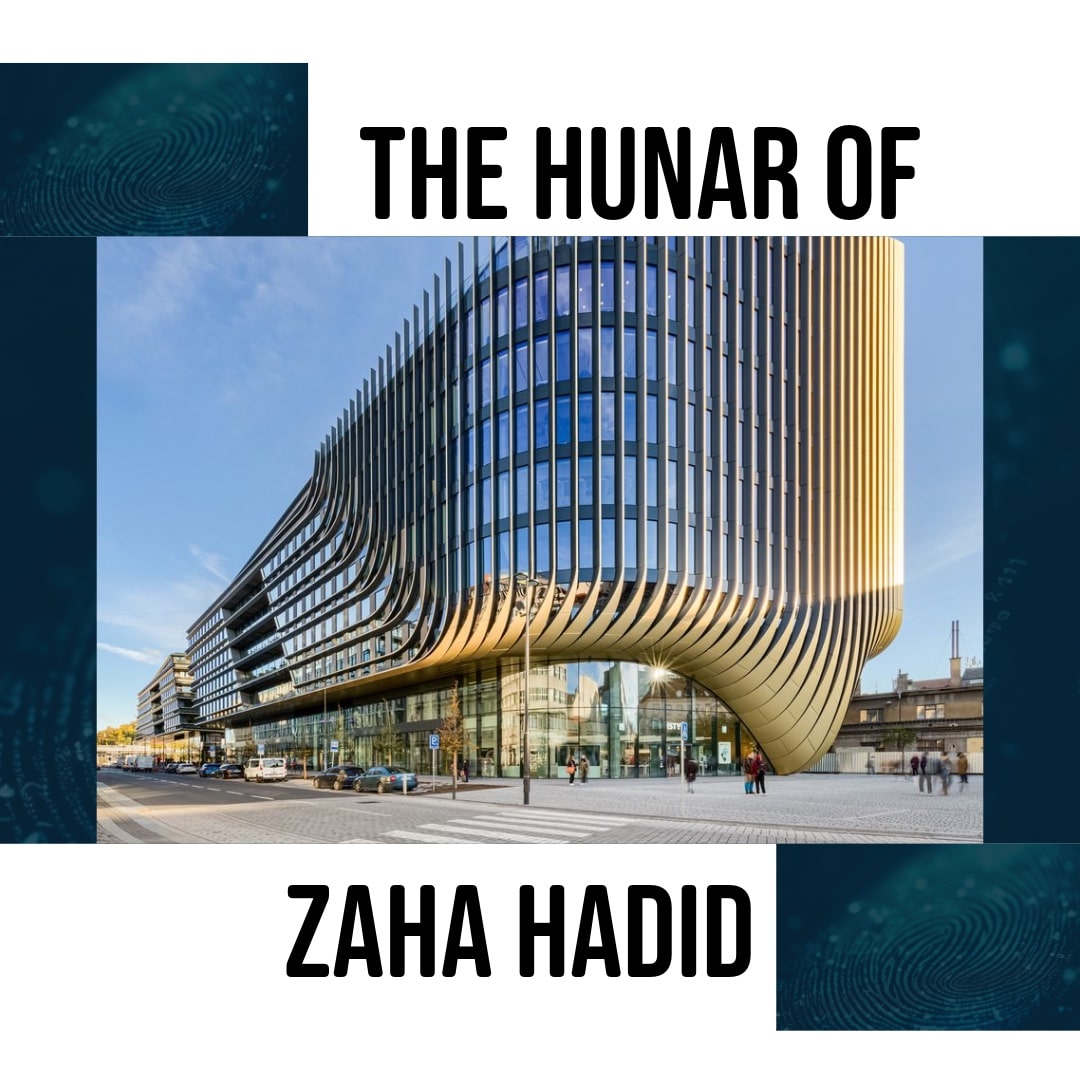
Hunar and the will to defy gravity
Hunar begins where comfort ends.
Zaha Hadid did not just design buildings. She challenged the assumption that buildings must obey visual gravity. Long before engineers could fully support her ideas, she was already sketching structures that seemed to float, tilt, and flow.
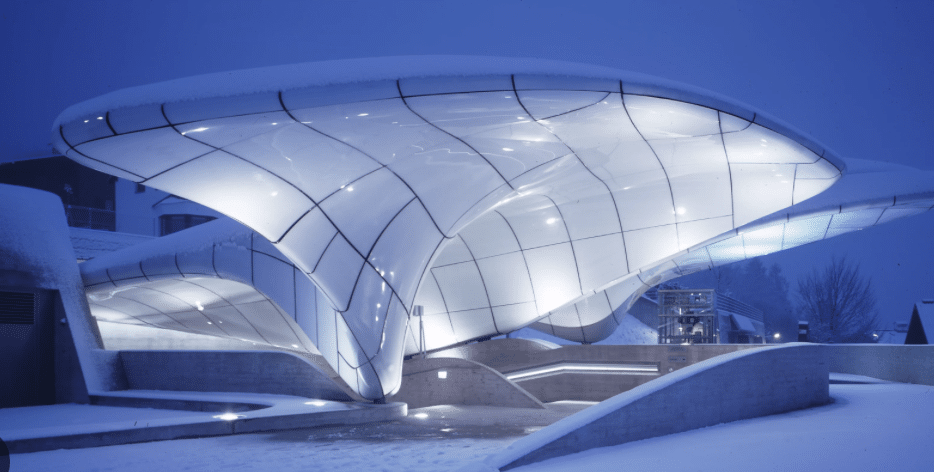
Her foundation was unusual for an architect. She trained in mathematics before architecture, which gave her a deep intuition for abstraction, geometry, and fluid systems. That is why her early drawings looked less like blueprints and more like fragmented landscapes in motion. This is the Nordpark Cable Railway Station in Innsbruck.
Hunar is distilled from life experiences
She was born in Baghdad to a politically active, progressive family. Her father was an economist and co founder of a liberal political party. Dinner table conversations were about ideas, systems, and the future. That early exposure shaped her comfort with challenging norms. Hunar often begins with the permission to think differently.
As a child, she attended a Catholic school in Iraq where discipline was strict, but the environment was culturally diverse. She later described how this mix of structure and openness influenced her thinking. You see that duality in her work. Freedom inside precision.
Her hunar was shaped by her life experiences.
Zaha Hadid and Identity
Hadid’s early career was defined by rejection. For years, she was known as a “paper architect” because her designs were admired but not built.
One of her breakthrough competition wins, The Peak in Hong Kong, was never constructed. It was considered too complex, too radical. Many would have adjusted. She did not.
Instead, she leaned further into her vision. Her paintings from this period were not decorative. They were analytical tools, influenced by Russian Suprematism, especially the work of Kazimir Malevich. She used painting to explore spatial fragmentation and movement before software could model it.
This is where Hunar becomes visible. She was not just practicing architecture. She was expanding its language. She was changing what the average person understood about the limits of architecture
She moved to London and studied at the Architectural Association, where she later became a professor. Rem Koolhaas, one of her teachers, recognized her as a “planet in her own orbit.” That is not talent. That is a distinct intellectual gravity.
She eventually became the first woman to win the Pritzker Architecture Prize. But even then, she resisted being framed by identity categories. She wanted the work to stand on its own terms. She designed her identity by being unique.

The discipline behind the impossible
It is easy to romanticize her work as artistic rebellion. In reality, it was grounded in extreme discipline.
The Vitra Fire Station, her first major built project, is all sharp angles and tension, almost like a building caught mid explosion. It reflects her early fascination with fragmentation.
Years later, the London Aquatics Centre appears completely different. A smooth, wave like roof that seems to hover effortlessly. What changed was not her core, but her range.
She was known for working long hours and expecting the same from her teams.
Digital tools became central to her practice, not as shortcuts, but as enablers of precision. She embraced parametric design early, allowing her to translate complex geometries into buildable structures.
Even her personal habits reflected intensity. She reportedly slept very little, traveled constantly, and maintained a global practice that spanned continents. Her life itself was in motion, much like her buildings. She would set standards by saying, “If you want an easy life, don’t become an architect.”
Designing a career that defies gravity
Zaha Hadid did not wait for the world to make space for her ideas. She created forms that forced the world to respond. That is the deeper lesson of Hunar. Anyone can learn design software. Anyone can acquire architectural skills. AI can now generate building concepts that look futuristic and structurally sound.
Hadid’s lens was shaped by mathematics, political exposure, cultural fluidity, artistic experimentation, and years of rejection. Each experience added a new dimension to how she saw space.
Most careers today follow predictable paths. Degrees. Roles. Promotions. An identity that fits neatly into organizational boxes. What I call an I C E identity. Interchangeable. Credential driven. Employer assigned.
Zaha Hadid chose a different path. She designed her identity the way she designed her buildings. Fluid. Defiant. Unmistakable.
The real question is not whether you have talent or skill. The future of work will depend on your being unique. It will not be about skills. It will be about your hunar.
The question is whether you are willing to design an AIdentity that reflects your Hunar. One that may not fit existing structures. One that might even feel impossible at first.
Can you defy gravity in your career.
AI can steal your skills. It can never steal your HUNAR.
Read more
The Smithsonian magazine showcased seven of her stunning designs <click this> My favorite is the Olympic Aquatic Center in London. It gives you the feeling of a swimmer about to dive in to this public pool.
Look at the Masaryk Center in Poland <click this>
The Guardian’s pick of 10 best buildings by Zaha Hadid <click this>