
Coal miners sent canaries into coal mines to see if the mine was safe for them. Canaries are like futurists who can warn you about the future that is impending. Stanford has built a canary dashboard for the Job Market. Here are the key findings.

When coal miners in Victorian England sent a small yellow bird down into a dark shaft before climbing in themselves, they weren’t being sentimental. They were being ruthlessly practical. If the air turned poisonous, the canary would fall before any human could smell the danger. It was an early warning system. Stanford just built one for the job market. Here is what it explains.
Oracle just cut 21,000 roles over the past year. AI was responsible for over 50,000 layoffs in the U.S. in 2025, with major firms including Salesforce and IBM slashing thousands of roles. Who is most vulnerable? Lets examine that.
Since AI arrived, which workers are falling first?
ADP processes payroll for over 26 million American workers. Now The Stanford Digital Economy Lab, in collaboration with ADP has been tracking the job market since November 2022 when ChatGPT launched.
They’ve been watching 4.6 million workers across 730 different occupations inside 25,000 real companies. You can see the live Canaries Dashboard here.
Their question is deceptively simple: since AI arrived, which workers are falling first?
A biologist would call this sentinel surveillance — watching the most vulnerable species to understand what’s coming for the ecosystem. An economist calls it a leading indicator. Your grandmother would call it common sense.
AI Layoffs Are A Structural Shift
Overall, employment is still growing. But look closer and the pattern gets uncomfortable.
Big tech entry-level hiring has dropped more than 50% over the last three years. That isn’t a rounding error. That’s a structural shift. UK junior developer openings fell nearly one-third versus 2022 levels, per LinkedIn workforce reports. A third. Gone. In two years. SQ Magazine
Indian IT services companies have reduced entry-level roles by 20–25% thanks to automation and AI, according to EY. Job platforms including LinkedIn, Indeed, and Eures recorded a 35% decline in junior tech positions across major EU countries during 2024. Rest of World
Only 13% of India’s 119,000 active tech openings are now for freshers. India produces roughly 1.5 million engineering graduates every year. OwnYourCareer
Economists call a demand shock hitting a specific node in the network. Pull out one generation’s entry point, and you don’t just affect that generation, you also hollow out the pipeline that produces the next decade’s senior talent.
Young, Ambitious, and First in Line for AI Layoffs
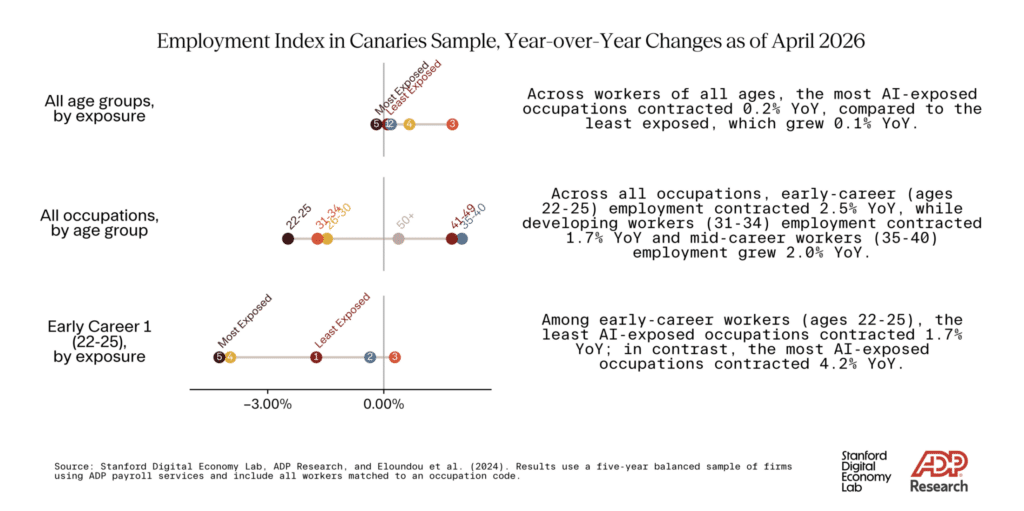
Stanford’s data is precise about who is feeling this first. Young workers, aged 22 to 25, in AI-exposed jobs are declining. Clearly and directionally. In this scenario think of the years of experience as lifeboats. The more you have, the more secure you feel.
A senior software engineer brings institutional memory, client relationships, architectural judgment the ability to ask the right question before a single line of code gets written. AI struggles to replace them.
AI can augment them greatly
A 23-year-old in their first job is still building those life boats. AI can do a surprising amount of what they were hired to do. Microsoft’s CEO Satya Nadella acknowledged, 20–30% of code in some Microsoft projects is now generated by AI. This statement was made months before the company’s software-engineering layoff round. If you read between the lines of Tech CEOs, you will very often notice that they are trying to prepare investors for what is likely to happen. So watch those.
Over 152,000 tech employees laid off across 551 companies in 2024. The 2025 figure reached roughly 122,549 affected employees across 257 companies. Across three years, the aggregate total exceeds 700,000 tech sector job losses. (Source: Layoffs.fyi)
Two jobs stand out most sharply in Stanford’s data:
- Junior software developers. Large declines for the youngest cohort. The people who were supposed to build the AI future are among the first displaced by it.
- Entry-level customer service representatives. Salesforce CEO Marc Benioff confirmed 4,000 customer support roles were cut as Agentforce AI took over routine conversations. Not a side effect. A stated strategy.
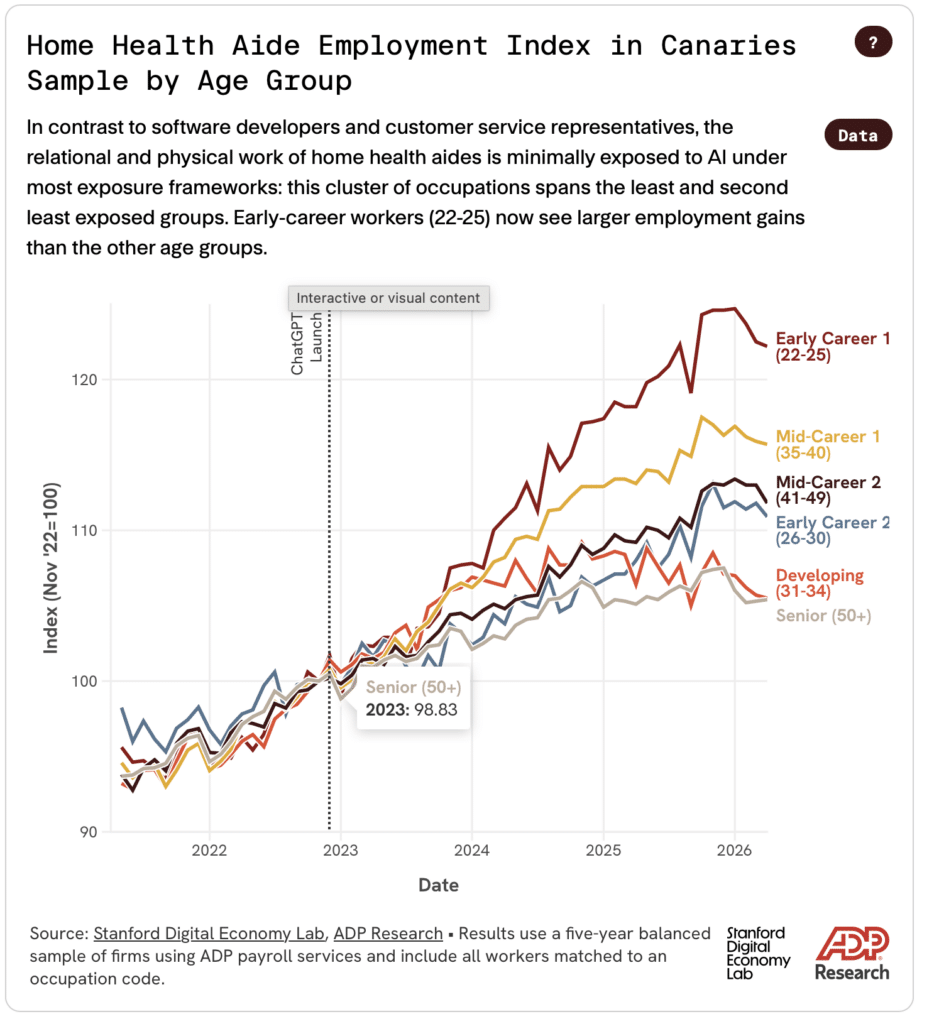
However, Home health aides ie people who assist elderly and disabled individuals with physical and daily care are growing in employment, especially for younger workers. AI cannot hug someone. Jobs that offer hugs (literally and figuratively) will continue to grow. Physical, relational, and contextual work has a natural moat against automation.
It’s How You Use AI
Stanford’s researchers make a distinction that I think is the most important finding hiding in plain sight.
They separate AI usage into two types:
a) Automation = AI does the task instead of you. The human exits.
b) Augmentation = AI helps you do the task better. The human stays, upgraded.
The data shows this distinction is everything. Occupations where AI primarily automates work see employment falling, especially among younger workers. Where AI augments? The employment picture stays calm.
This is a classic substitution vs. complementarity problem. And companies are choosing between the two paths every time they deploy a new AI tool. One creates efficiency short-term. The other creates capability long-term.
A chef analogy: automation is buying a machine that cooks the meal entirely, making the apprentice redundant. Augmentation is giving that apprentice a smart oven with sensors. They become faster, more skilled, more valuable.
What This Means in Delhi, Bengaluru, Manchester, and Beyond
India’s IT industry, valued at over $250 billion and employing millions, is facing its toughest year yet in 2026. Over 100,000 IT job losses occurred in India in 2025, driven by AI integration and post-pandemic adjustments. India produces 1.5 million engineering graduates annually. If only 13% of active openings are for freshers, a generation is entering a labour market where the traditional first rung of the ladder has been sawn off. Ytcventures
This is where companies like Hunar.AI matter. This is an Indian platform using conversational Voice AI and WhatsApp to connect frontline workers with opportunity at scale, meeting candidates in the languages they actually speak, not the ones enterprise software assumes they do.
🇬🇧 British universities are still producing computer science graduates at pace. The question is whether they’re producing graduates with the right skills. The market needs people not just to write code, but how to direct, evaluate, and work alongside AI that ALSO writes code.
A generational bottleneck. If the training ground for senior roles disappears, the organisational bench of the 2030s gets thinner. Middle management gaps follow. Then leadership gaps are inevitable.
Employee fears of job loss have jumped from 28% in 2024 to 40% in 2026. Anxiety at that scale changes behavior especially risk appetite, career choices, educational investment etc. When a society loses its risk appetite, innovations taper off.
The Data Gives You Time To Make Choices
Stanford has built that system for the labour market — live, monthly-updated, anchored in real payroll data from 25,000 companies. It tells us where the pressure is building before it becomes a crisis.
Structural shifts give us time to see where the new opportunities may be next. It is usually in areas where not too many people are there. So the employers are willing to hire even when they know the applicant does not have deep expertise. So be prepared to rethink your career in ways you may not have ever done so before.
Email me: AbhijitBhaduri@live.com