
Nvidia reported a 3.7% turnover rate for fiscal 2026. More than 40% of new hires came through employee referrals. Their retention strategy is based on a combination that is considerably harder for a competitor to replicate. It is a system of interconnected choices, but there are many ideas you can design based on Nvidia’s philosophy.
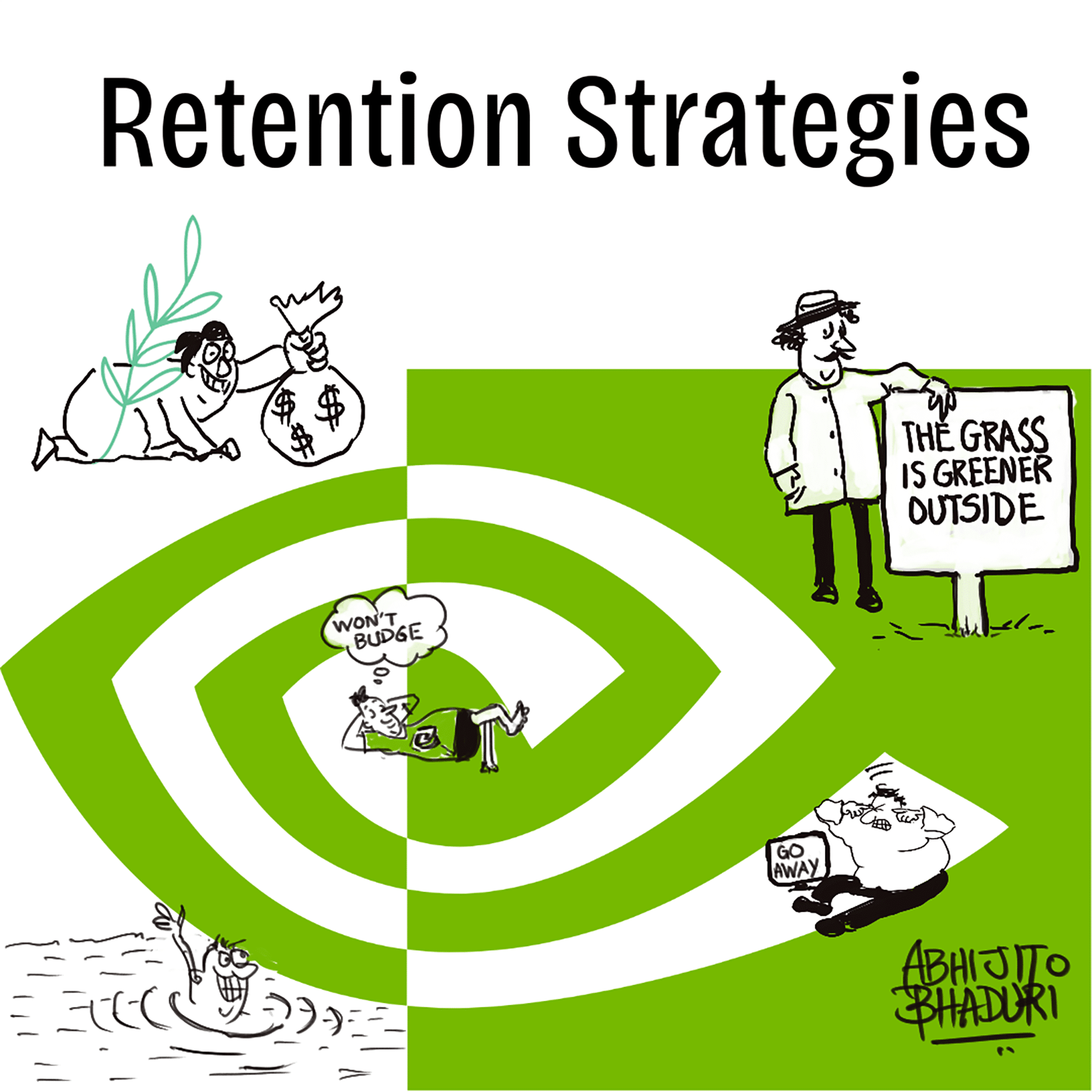
Nvidia culture makes several deliberate choices that make talented employees harder for competitors to lure away.
Nvidia Culture places mission before hierarchy
Nvidia describes its culture as one team, with people forming around projects and skills rather than traditional hierarchy. Its CEO, Jensen Huang, maintains an unusually large number of direct reports.
Employee listening plus autonomy
Employees get access, not just autonomy. Ideas can come from interns, junior employees or senior engineers. Suggestions receive a response rather than disappearing into an employee-engagement system. One suggestion eventually became Nvidia’s quarterly company-wide “Free Days.”
Nvidia shuts down for two additional days each quarter. The important detail is that everyone stops together, so employees do not return to a mountain of email generated while they were away. Nvidia’s 2026 calendar confirms eight such Free Days across the year. That means, recovery from stress is built in to the work rhythm (see why this matters)
Compensation and Benefits are Employee Centered
- Employees participate in the upside. Nvidia’s ESPP allows eligible employees to purchase shares at a 15% discount, with contributions of up to 25% of salary, subject to plan limits.
- Nvidia supports areas including family formation, student debt, aging parents, financial planning and neurodiversity. The philosophy is broader than workplace convenience.
- AI becomes part of the work rather than a separate transformation program. Nvidia reports that more than 80% of its workforce is in technical roles and that employee development includes on-the-job learning and tuition support.
Here is the result: Nvidia reported a 3.7% turnover rate for fiscal 2026. More than 40% of new hires came through employee referrals. Nvidia therefore illustrates an important choice: companies can try to retain people through control and convenience, or through contribution, belonging, upside and trust.
Future of Work: What travels
Copy the voice, not the org chart
Companies can adopt employee listening, project-based teams, quarterly recovery periods and stronger profit or equity participation. Brand, sales and innovation teams already operate through cross-functional projects. This would work very well in FMCG.
The Nvidia-style flat structure is less transferable in manufacturing, where safety, quality and supply-chain accountability require clear authority.
Copy the mission, provide access
Banks and insurers can give employees greater access to senior decision-makers, faster experimentation and stronger ownership of customer problems.
They cannot eliminate hierarchy where regulation, risk management and segregation of duties require formal accountability.
Copy the listening
Healthcare organizations can learn from Nvidia’s employee voice model. Nurses, clinicians and frontline staff often see operational problems before executives do.
The strongest transferable idea is simple: make employee feedback consequential.
A hospital cannot operate like a chip-design company. Patient safety requires protocols, credentials and escalation paths. But bureaucracy does not have to determine how ideas travel.
Where Nvidia will not work
The full Nvidia model is unlikely to translate directly into highly regulated, safety-critical or heavily unionized environments where formal roles, compliance and decision rights are essential. The deeper lesson is more portable.
Do not copy Nvidia’s perks. Copy its choices. Give talented people meaningful problems, access to decision-makers, a voice that produces visible consequences, a share of the upside and genuine time to recover.
That combination is considerably harder for a competitor to replicate than another perk or benefit.
Follow me on Linkedin at https://www.linkedin.com/in/abhijitbhaduri/
You can join my free weekly newsletter https://www.linkedin.com/newsletters/6739009776786698240/