
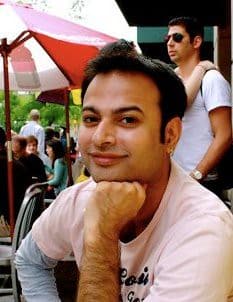
 Chapal Mehra is a publishing professional with over a decade in the Indian publishing industry. He began is career as a commissioning person at McGraw Hill and later worked at the Oxford University Press and Sage Publications. His last full-time assignment in publishing was as Acquisitions Manager at Penguin India. He has worked on consulting assignments with Harvard Business School Press, United Nations Development Program and the Global business Coalition Against HIV/ AIDS. He is a graduate of New York University and is currently based in New Delhi and works as a full-time strategy and content consultant. Ask Chapal about the authors he has introduced to the market and the list is impressive. The three he always mentions are (a) We Are Like That Only by ex-McKinsey consultant and Marketing thought leader Rama Bijapurkar was the bestselling book in the non-fiction and business category for over 2 years(2007-9) and still continues to be hugely successful book in its revised avatar. Chapal had chaperoned that book into the market. (b) Arun Maira’s Remaking India was considered a path breaking book in the application of consensus building and conflict resolution in business to national politics and development. (c) The Romance of Tata Steel by RM Lala has been critically hailed as a definitive biography of this great Indian organization.I thought it would be great to have his perspective that first time authors could benefit from.Abhijit: What were you looking for when you commissioned those authors?Chapal Mehra: I think some of the better known writers that I have commissioned at various times include Arum Maira, Rama Bijapurkar, Kaushik Basu, Santosh Desai and Jerry Rao. Not all these books came to fruition but those that did were quite successful.I think the fundamental qualities that one looks for in an author is a deep understanding and passion for the ideas that they want to write on, an innovative perspective on the subject and a reasonably good writing style along with a fair bit of flexibility. New ideas are very, very important as is context which makes it relevant to the immediate market that you are addressing. A book as you know is a collaborative process. A writer entirely left on their own is often insular. Unless of course, s/he is an absolute genius. But how many of those exist?Abhijit: As a writer how does one know which publishing house is the right one for me?It works differently for different genres but a few simple rules apply.A natural point is that the publisher should a considerable presence in the market you wish to address. Every brand, however big, has specializations or sub brands. Make sure you are with the right brand which has the infrastructure to bring you to your reader. A big brand which is not player in the area you are writing on is useless for you . For eg. An academic book is well-regarded when it comes from a university press instead of say Penguin. The next, of course, is that the publisher should have substantial content or similar books like yours, for eg. you cannot do an engineering book with a social science publisher . It would be lost. So having a companion list is important. Having a companion list ensures that the subject area gets enough attention by marketing and promotion and also your book rides along with other books. You also need to look at what the publishers strongest points are – editorial, marketing or sales? You have to understand your partners strengths and weaknesses and what they can provide you best.Finally, your publishing house and editor have to believe in the idea that you wish to write on. It has to be a combined passion of sorts. You cannot start your first book with someone who doesn’t share your excitement. The sad thing is that in India this paddling pool is tiny.Abhijit: Should the first time writers have agents?Chapal Mehra: Sure. If you can find one you like and who delivers for you. Its tricky especially in India. You need to know the following : What is the role of the agent? What do you want them to do ? What do you see them providing are all things that need to be discussed before you embark on the agent relationship. It also depends on the agent you get.Whenever I have acted as an agent I draft a strategy with the writer before we sign anything and make it clear to them what it is that I can deliver. And there is usually a follow up plan . As an agent the fun for me is to over deliver. I am also brutally frank with authors whose work I don’t think has international audience. Its better of they hate you now rather than later. We start with clear goals and work towards them instead of having some hazy idea of making you rich and famous.Writers often overestimate the service that agents can provide. Every agent is not going to take you international with a big fat advance. And really do you deserve that? Also you must learn from other examples worldwide. How many authors travel internationally across the world to you? Does everyone have that potential? Clearly notBefore you get an agent, you need to be sure and clear about what you want the agent to do for you. There are a lot of editorial inputs that agents can give. They can also open the right doors for you in the publishing companies and advise you on the appropriate marketing and publicity strategy. But there are agents and agents so please be sure what you want from them .Abhijit: How should a writer choose an agent?Chapal Mehra: Like I said earlier, before you choose anyone be objective and determine for yourself what you want for your book. If you are not Murkami, Ishiguro or Rushdie you need to be a little bit realistic in the goals you set for your work.So for starters, your vision of the book and the agent’s vision of YOUR book have to match. You have to agree on who the primary audience is, where it should be published and how it should be marketed. Again its like a long-term relationship. You need to be sure you want the same things and agree on a common set of goals and these can include things such as specific deliverables such as advances and marketing .And in case you don’t know what you want, then you have to be guided by your agent but also do your little bit of research. Agents are like all other consultants, some deliver exactly what you want, some deliver more, some just don’t deliver. Remember the list of deliverables that you draw up helps the agent and you. Michelangelo didn’t paint the Sistine Chapel by accident –he planned it.Abhijit: What are the most common mistakes first time authors make? How should one avoid doing those?Chapal Mehra: Oh they are endless:
- Wrong agent
- Wrong publisher
- No idea of what they wanted for their book except that it should get published
- No idea of the terms of the agreement they signed
- No idea of their intellectual property subclauses
- Not enough discussion on how the book will be marketed and promoted
Most assume that the publisher is doing them a favor by publishing their book. Hence they refuse to ask any questions and later complain about how they were tricked. This is at heart a business transaction. So you need to be sure what you are getting into. No one is doing you a favor. It is also an intellectual transaction so you need to be doubly sure that your ideas are cared for and promoted. That having been said, first time authors can also be real nut cases. Some of them think that the Nobel Prize for literature is theirs and drive their agents and editors nuts with questions queries and endless heckling. There is a limit to everything . I always tell such authors if you think you are such a genius. Go elsewhere. And truthfully, when such a genius arrives every editor or publisher puts up with their tantrums. So if I am not putting up with yours. You should take the hint.Abhijit: What are some of the watchouts for first time writers when they sign a contract with a publishing firm?Chapal: Most professional publishing firms have standard contracts which they are not open to amending. It is the way they do business and these cannot be altered to every author’s requirement. In fact they are mostly standardized across organizations with a few changes here and there. As a first time author you need to know what you get into a contract with the publishing firm for :Copyright: Understand the difference between copyright and the right to publish.What territory are you signing the book deal for? Do you want to keep US and UK or Europe rights for yourself?Please check the royalty clause. Are you happy with what the standard royalty is ? Usually it’s the same across publishing firmsPlease check the subsidiary rights. Do you want to give up or keep –translation rights, film rights, tv series rights etc. In most cases I would advise its best to let the publishing company keep these unless you want to do something with them or you think it will have enormous potential which you have a strategy to exploit.If its an advance contract what are your dates of delivery? What are the conditions associated with non- or late delivery?Its always good to discuss the contract with your editor to also understand why the organization is offering the contract that it is . Most large professional publishing firms are not out to rob you. But its important for you to understand their thinking.Abhijit: What are the typical amounts payable as advance to writers. How does one get these million dollar advances that one hears of?Chapal: Before we discuss an advance lets understand the nature of it. An advance is a monetary commitment to a writers work. This work is a product that the publisher hopes to sell. The advance is built on the foundation that the book will sell in certain numbers. Some authors labour under the impression that large advances are always doled out . Its only a fraction of writers that get such advances. It depends on what genre, the potential and the ability of a publisher to pay. Some advances from international publishers seem big because you multiplied them by 50 really! Its not too high in India unless you are a well-established writer or the book has huge potential. It can range from Rs40,000 to a few lakhs . In any case, these huge advances are only possible if the mathematics are done properly. Most standard advances in fact are adjustable against future royaltyThere isn’t a standard strategy to getting that multimillion dollar advance. It depends on the potential of your work and the capacity of your agent. I know of people who have written to a big publishing firm directly and been offered reasonable advances because their work is good. others usually get it through agents. So there isnt a single strategy. And what are multi-million dollar advances? I million dollars is the equal of 5 crores in India .Which Indian writer has received these recently? Only a handful …——————–My favorite website in this respect would be http://www.advicetowriters.com/ They have loads of stuff you will read and learn from. Must read.Should you have an agent and such vexing questions answered here http://www.thehindu.com/arts/books/article611600.eceI found this article useful Ten rules for writing fiction
4 Comments
It would have been a a great article if Mr Mehra wasn’t so negative, moreso about writers from the sub-continent itself.Sure there are not great literary agents in India I understand,but that has not prevented great Indian writers from coming into their own.Need I mention Arundhati Roy and Pankaj Mishra?Their agents weren’t Indian,yes but it’s about time someone gave credit where it’s due.Sashi Warrior and Upamanyu Chatterji are among some great Indian writers who haven’t been given their proper due and as such quite comparable to North American writers.Does Mr Mehra know that Indians are the third most-published ethnic group after the Brits and the Americans and come to think of perhaps it just be the only field were the Indians might be better than the Chinese.
I don’t think the interview is negative at all. In fact, the interview is very useful and provides an excellent roadmap for writers to deal with the process of publishing for the first time. It also has an effective list of do’s and dont’s . I don’t think he mentions Indian writers anywhere except when he talks of multi-million dollar advances in writing. And it is true that few Indian writers get those advances. But how does that become negative?@ Sashi….And that comment about the Chinese…wow …you sound like someone with a negative jingoistic agenda !
‘Negative jingoistic agenda?’Sorry that does not make sense.You can be either jingoistic or negative,not both.Having made several trips to India and China I can honestly say that the Chinese are well ahead…………the average Indian might be a lot more sophisticated and have a few extra degrees but the average Chinese is still more hardworking and perhaps more jingoistic if it indeed comes to that.What I had meant when I implied that Mr Mehra was negative was when he said something to the effect of ‘only a handful’ had received something like a million dollar advance.Why restrict this comment to Indian writers only?VERY FEW have received THAT kind of advance.Sure it offers a great perspective on writing but it didn’t do any justice to the great many number of Indian writers out there and I don’t care if I sound biased.And yes, India might actually be ahead of the Chinese when it comes to the publication of Literary fiction.So much for ‘ negative jingoistic agenda.’
I want to get my poems and crime fiction to be published and marketed globally.I have written them and contacted a few but in vain.May I know in what way you would like to help me or advise me.