
Technology has a strange way of hogging the limelight and then becoming invisible like electricity or your mobile phone. AI agents have moved from the attention-grabbing phase to becoming invisible. They have entered the enterprise. HR must take charge of their onboarding and integration.

AI agents now read your data, make decisions, and take independent actions like sending emails, updating records, issuing refunds. The moment software can act instead of just answer, it stops being a tool. It starts being a teammate. Teammates need to be onboarded, coached and tracked just like any other employee.
The moment software can act instead of just answer, it stops being a tool.
AI Agents Are Team Members – Not Software
Here are three ideas to frame the picture. Agents that can talk can sound annoying when they loop on a request. They can even fool us that they have real feelings and care for the customers – they do not. Have you tried changing a flight while the AI agent finds new ways to annoy you?
The AI agents that can ACT are like the teenagers who can swipe your credit card or drive your car when they are not supposed to. In the same way a chatbot might say something wrong. But an AI agent might do something wrong like delete a database, send money to the wrong place, leak a document it shouldn’t have touched.
That is why this isn’t an IT story anymore. It’s an HR story.
The Watercooler Risk
I remember a new hire sending a client a reminder about the meeting next week. I leave you to guess the age of the new hire who wrote an email that began,
“Dude,
We’re actually meeting IRL next week bro. Excited!”
We had to do some serious damage control. An unmanaged agent could do worse.
It can act at the speed of a computer and across every system it touches all at once. That’s an unmanaged AI agent. The fix isn’t more code. Think of the agent like a new hire. You want to give it a role, a supervisor who checks and closely monitors the work until she is convinced that the new hire knows enough to be given some freedom and flex in measured doses.
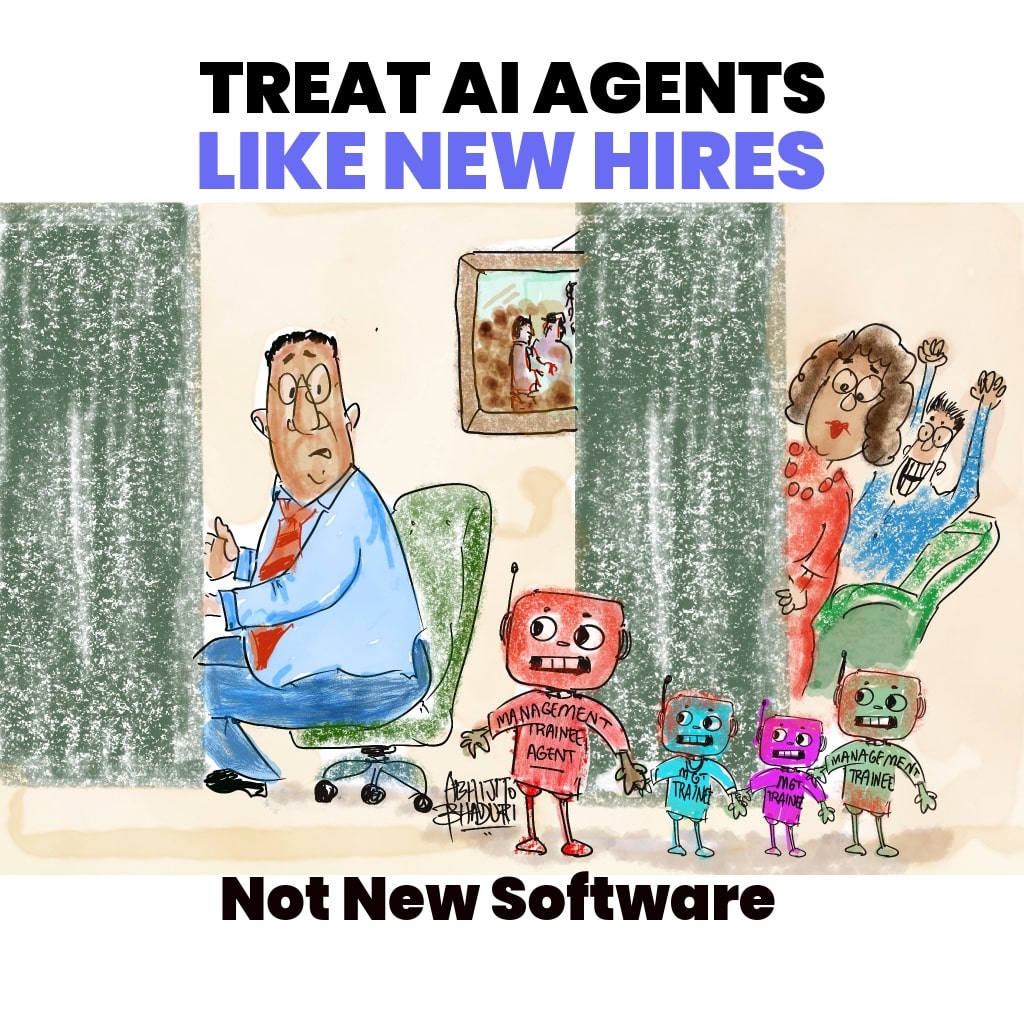
It’s the same fix you’d use on a human: give it a role, a scope, a supervisor, and a way to check its work.
The Best “AI Agent Managers” Will Be Coaches
At Salesforce, AI agents now resolve nearly three-quarters of inbound customer support cases on their own. They draft emails, route hard cases to humans, and learn from feedback just the way a new employee does. A brand new job title, “agent manager,” is emerging just to supervise this hybrid workforce. Expect it to be a standard title at AI-first companies within the next few months. The people best suited for it, will be the people who already managed quality, service, and judgment calls. Managing an agent is less about code and more about coaching.
Skills inventories will give way to capability ecosystems. Beyond employee skills the ecosystem will have assets like AI tools, data, mentors, communities, experimentation platforms and decision autonomy.
Implications for Talent Management
If agents are teammates, then HR needs to rethink its role. At every step the design will have to be a combination of humans plus agents. Job descriptions will need to cover software, not just people. Performance reviews need new metrics because metrics like “calls made per day” mean nothing when someone is supervising fifty agents instead of doing the work themselves.
A brand-new role, the agent manager, will shape career paths. This new role has no existing hiring pipeline, no job ladder, and no market rate … yet. If agents absorb the repetitive, entry-level tasks people used to learn on, where does the next generation of experienced managers sharpen their judgment from? When something goes wrong, while it is tempting to blame “the agent”, the accountability must still lie with the human. When the intern or AI agent deletes an entire folder, it is the manager and not the intern (or agent) who must be held accountable.
Onboarding AI Agents
The HR teams must rethink the onboarding process to include the employees running on code. That includes making sure the job descriptions and work scope are sharply stated.
- Give every agent a job description.
Just like a new employee needs to know what they’re responsible for, an agent needs the same. What is it allowed and what must never happen, even if someone asks it to. Think of the damage a new hire with unfettered access can do. Who is the human accountable for what the agent can and cannot do autonomously or under supervision must be specified. Skipping this step for a person would be considered bad management. Skipping it for an agent is currently the industry default. That must change.
2. Give every agent a supervisor
Give every agent a supervisor. New hires know on day one who their manager is. Agents too need a real person who is accountable for its performance, achievements and failures. The supervisor should regularly monitor and check the agent’s work. An agent working entirely unsupervised is like a new hire left alone in the building with the keys to the safe and no instructions.
3. Progressive onboarding
A new employee doesn’t get full authority in their first hour. They shadow, they learn the culture, they earn trust gradually. Treat agents the same way. Let a new agent handle low-stakes tasks first and only over time . Assign bigger responsibilities after the supervisor is comfortable that the AI agent has proven that it can do the smaller jobs well. This single idea is probably the most useful and most skipped step in agent deployment today.
Review it on a regular schedule, the way you’d review a person. New hires get 30-60-90 day check-ins. Agents need scheduled evaluations that are detailed. Not just “does it work,” but is it accurate, is it fast enough, is it staying inside its boundaries. Skipping performance reviews for a human would be a red flag. It should be a red flag for an agent, too.
Maintain Your Agency
When people say “the AI decided,” it becomes very easy for everyone to stop feeling responsible for the outcome. Giving an agent a clear identity – a name and a defined role, keeps humans owning the outcome.
Everything here is borrowed from onboarding a human. You already know how to do this. You’ve just never had to do it for something that isn’t a person. When it comes to a tool we would often say, “The tool does not sit outside you, politely waiting to be picked up. It works its way in.” When tools become teammates, we need to design systems the way we assume both good and evil versions for humans.
Read More
- Srinivasan, S. & Wei, V. (2026). To Thrive in the AI Era, Companies Need Agent Managers. Harvard Business Review. https://hbr.org/2026/02/to-thrive-in-the-ai-era-companies-need-agent-managers
- Telang, R., Hydari, M.Z. & Iqbal, R. (2026). To Scale AI Agents Successfully, Think of Them Like Team Members. Harvard Business Review. https://hbr.org/2026/03/to-scale-ai-agents-successfully-think-of-them-like-team-members
- Fuller, J. (2026). Create an Onboarding Plan for AI Agents. Harvard Business Review. https://hbr.org/2026/03/create-an-onboarding-plan-for-ai-agents