
Our talent systems were designed for a world of abundant talent. Talent is routinely discarded after use. Retain, Retrain, Return and Reimagine are the four pillars of the circular economy.
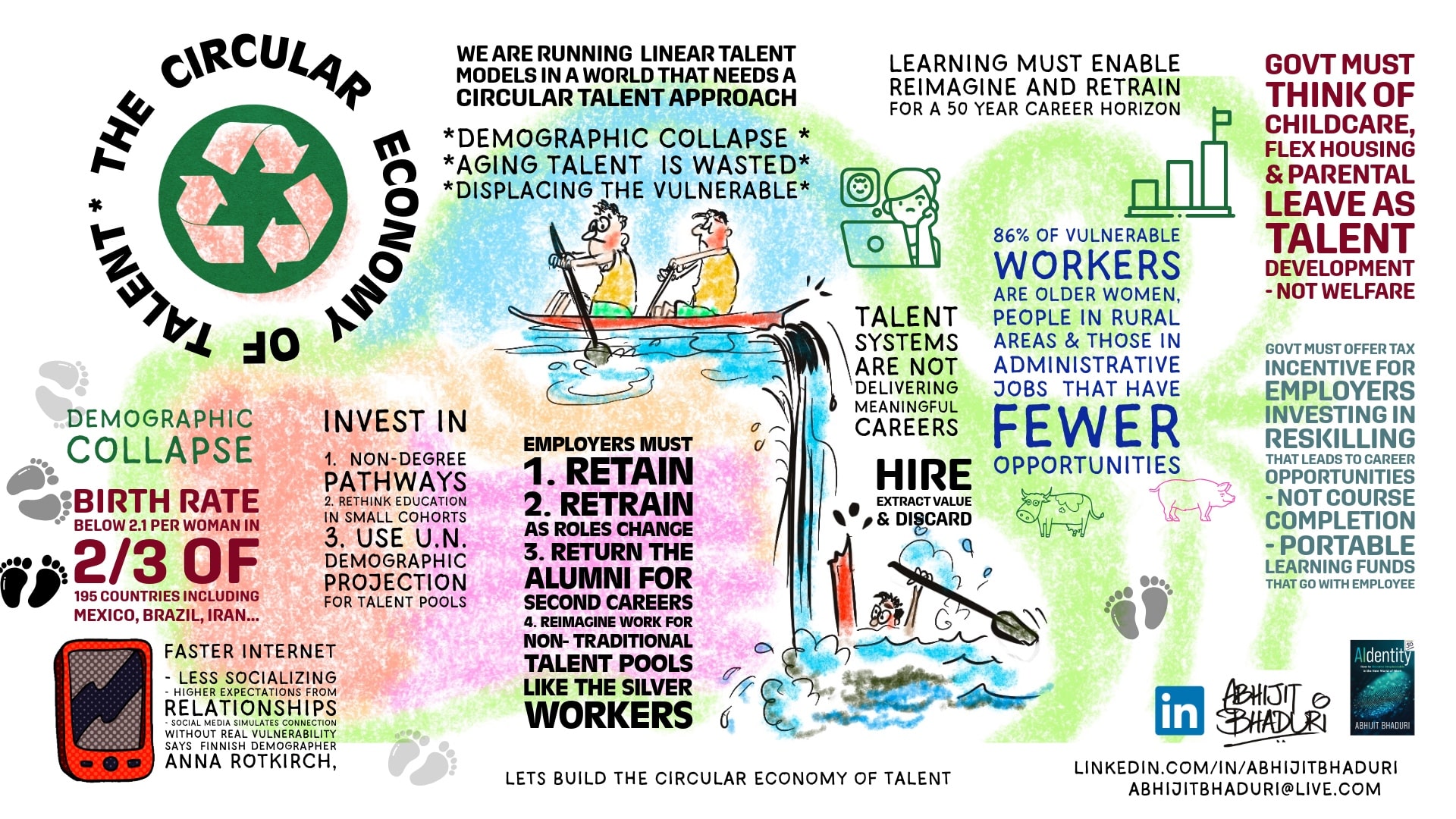
We built a talent system for a world that no longer exists. We still assume that the talent supply chain is one with an endless supply of young workers. That world is gone. What comes next requires us to stop treating talent like a disposable resource and start treating it like a circular one.
We are running a linear talent economy in a world that demands a circular economy.
Think about how we use plastic. We make it, use it once, and throw it away. We’re doing the same thing with people.
The current model of talent management works like this: hire young → extract maximum value → discard when inconvenient. We call this “workforce management.” It is, in reality, a form of industrial-era waste. Single use talent models are corrosive to society.
The circular economy of talent
The circular economy, a concept borrowed from sustainability says: nothing gets thrown away. Materials are repaired, reused, repurposed. The Circular Economy of Talent asks the same question: what if we never discarded a capable person simply because they were the wrong age, in the wrong place, or between career chapters?

Demographic Time Bomb
Here’s the problem driving the urgency: birth rates are falling in two-thirds of the world’s 195 countries, with many now below the 2.1 children per woman needed to sustain a population. South Korea is an extreme example. Women there say they want two children, but are having 0.7. This is not a personal failing. It is a systemic signal. The era of infinite fresh talent is ending, even in countries like Mexico, Brazil, Tunisia, and Iran.
Our brains are wired to conserve energy by using the most familiar pattern. For decades, the pattern in talent was recruit young, replace often. Breaking that default requires deliberate, effortful thinking. Organisations rarely build this behavior into their incentive structures. The first step to fixing the talent crisis is making the invisible habit visible.

Demographic collapse is not a future problem. It is already reshaping who is available, where they live, and whether they’ll show up
Here’s a metaphor: imagine a river that has been flowing strongly for a century suddenly slowing to a trickle. You can’t fix that by digging deeper into the dry riverbed. You have to redesign the entire water system.
The demographic slowdown is that trickle. And it is driven by something surprising: technology and aspiration.
What if we never discarded a capable person simply because they were the wrong age, in the wrong place, or between career chapters?
Faster internet and smartphones are redesigning how people socialise, partner, and commit. Finnish demographer Anna Rotkirch found that social media simulates connection without the real vulnerability that leads to lasting partnerships. The result? Less in-person socialising, higher expectations for relationships, and “curated fantasy makes people stay single forever.” People are not having fewer children because they are selfish. They are having fewer children because the architecture of modern life makes it extraordinarily difficult.
Meanwhile, hybrid work that is often celebrated as liberation has quietly amplified loneliness. The workplace, for all its flaws, was one of the last reliable spaces where people built unplanned, cross-demographic relationships. When we removed it, we did not replace it with anything.
What this means for talent: the pipeline is not just shrinking. It is changing shape. The workers of the next decade will be older, more geographically dispersed, more female, and more likely to have non-traditional career paths. Organizations were not designed for these realities. Skill gaps, the data says, are not individual failures. They are system design failures because the result of talent systems built for a 20th-century demographic that no longer exists.
The solution is a three-actor system where government, employers, and individuals each play a non-negotiable role
No single actor can fix this alone. A circular talent economy requires coordinated action much like a three-legged stool. Remove one leg and everything collapses.
The most vulnerable workers in the AI disruption are not who most people imagine. The real crisis sits in the administrative layer ie routine knowledge work that will be automated first. 86% of these vulnerable workers are women. Rural areas have fewer alternatives. Older workers with a single, narrow skill set are particularly exposed.
This is not a welfare problem. It is an infrastructure problem and infrastructure requires collective investment.
Here is how responsibility can be crafted:
Governments shape talent infrastructure
- Create tax incentives for employers who invest in reskilling (not just hiring)
- Build portable learning funds — money tied to the worker, not the employer, so it travels with them across jobs
- Reframe childcare not as social welfare but as talent development infrastructure. A country that makes it impossible to raise children and work simultaneously is designing its own talent shortage.
Employers: retain, retrain, return and reimagine
- Retain: invest in careers, not just roles; the 4-year hire-and-replace cycle is economically illiterate at current talent scarcity
- Retrain: when roles change due to AI, absorb and redeploy rather than release
- Reimagine: tap non-traditional talent pools: older workers (“silvers”), career returners, people in smaller cities
- Return: build alumni networks as a second-career pipeline; the person who left may be exactly who you need in five years
What you must take charge of
- Build a financial cushion: career transitions will be more frequent; cash runway is career resilience
- Develop portable skills: abilities that transfer across industries, not just roles
- Think in geography: AI disruption is not evenly distributed; location strategy matters more than it did
- Invest as if you are funding a 50-year career: because you probably are
The framework in one sentence
The question is no longer “How do we attract young talent?” It is “How do we make sure no capable person is ever permanently discarded from the economy?”
That is the shift from a linear talent economy to a circular one.
And the organisations and countries that make that shift first will not just solve a talent problem. They will build the only sustainable competitive advantage left: the full use of every human being’s potential, at every stage of their life.