
FOBO is the Fear Of Becoming Obsolete. Staying relevant in the AI economy means building organizations around problems not functions. This is the time to innovate.
FOBO And The Future Of Talent
FOBO is rising. AI adoption is uneven. Talent systems are not keeping up.
The Neuroscience of Freezing
There is a new fear at work. Not losing your job, but losing your relevance. FOBO captures something subtle but powerful. People are not just worried about being replaced. They are worried about being left behind while the job itself changes around them.
When your brain detects a threat — a predator, a deadline, a colleague who suddenly seems to know more than you — it triggers the amygdala. This is your brain’s oldest alarm system. It was built for escaping lions, not navigating large language models.

The amygdala does one thing brilliantly: it shuts down the parts of your brain you need most right now.
The prefrontal cortex — your learning brain, your curiosity engine, your “let me figure this out” centre — goes quiet. Blood flow literally redirects. Your body prepares to fight or flee. But there is nothing to fight. Nowhere to flee. So you freeze.
You sit in meetings about AI and nod. You tell yourself you will learn it next month. You watch a younger colleague build something in twenty minutes that took you two days and you feel something you cannot quite name.
That unnamed feeling is FOBO. And while you are busy feeling it, your brain has quietly stopped learning.
This is the cruel neuroscience of obsolescence: the fear of falling behind is the very thing that makes you fall behind.So you have two realities coexisting. Technology that is moving quickly. Organizations that are moving slowly. And people caught in between, trying to make sense of it.

Talent Systems Are Making It Worse
This is where things get uncomfortable. The fear people feel is not just coming from AI. It is coming from how organizations are responding to it.
1. They treat AI like a productivity tool
That worked in the past. Every new system made people faster. So the instinct is to measure gains in efficiency. But AI is not just about speed. It changes what one person can do. A junior employee can now perform parts of a senior role. A non technical employee can analyze data or build content that once required specialists.
If you only focus on productivity, you miss this shift. You optimize the old game instead of playing a new one.
2. Companies are centralizing AI
This also made sense before. New technology needed control. But AI creates value through use cases, and those live with people doing the work. When you lock AI into a central team, you get presentations, not transformation. Meanwhile, employees experiment quietly. A hidden layer of innovation forms that leaders cannot see.
3. Rethink talent
Defined roles. Fixed metrics. Annual reviews.
But the most valuable employees today are not the ones who stay within their roles. They are the ones who stretch them. They use AI to do things that were not part of their job before. The problem is, the system does not know how to recognize this. So the wrong people get rewarded, and the right ones feel invisible.
Over time, this creates a dangerous pattern. The people who embrace AI pull ahead quickly. Others hesitate, sometimes out of fear, sometimes out of pride. The gap widens. Eventually, the fear of becoming obsolete becomes real for those who resisted the change.
This is the cruel irony of FOBO. The fear itself can lead to the outcome people want to avoid.
Build Talent Systems That Reduce FOBO
If the problem is not just AI but how we manage talent around it, then the solution has to start there.
Think problems to solve not departments
Here are 3 easy-to-implement ideas for redesigning your org around problems, not roles:
1. Name your teams after the problem, not the function
Instead of “Marketing Team” or “HR Department,” rename working groups after the problem they exist to solve. “Talent Scarcity Task Force.” “Customer Churn Squad.” “AI Adoption Unit.” This single shift of terminology changes what people think their job is — from performing a function to solving a problem.
Run a 30-minute workshop this week where each team rewrites its own name as a problem statement.
2. Run a monthly “problem owner” meeting — not a department head meeting
Replace one standing leadership meeting with a gathering where each person presents not their department update, but the one problem they own this month — what they tried, what they learned, what they need. No titles at the table, only problems. This costs nothing to try and immediately surfaces where accountability is vague or where the same problem is being “owned” by three people simultaneously.
3. Post a visible “Problem Board” — physical or digital
Create a shared Miro board, Notion page, or even a whiteboard in the office with two columns: Problems We’re Actively Solving and Problems Nobody Owns Yet. Every team adds to it weekly. The second column is the most valuable — it makes invisible gaps visible and invites people to self-select into work that matters. This takes under an hour to set up and becomes a living org chart of real work.
The principle behind all three: make the problem the unit of organization, not the person or the department. Start with language, then meetings, then visibility.
Encourage experimentation
Set direction from the top, but do not control every move. The best ideas will come from people closest to the work. Create safe spaces where employees can try things without fear of being wrong. Share what works so others can build on it.
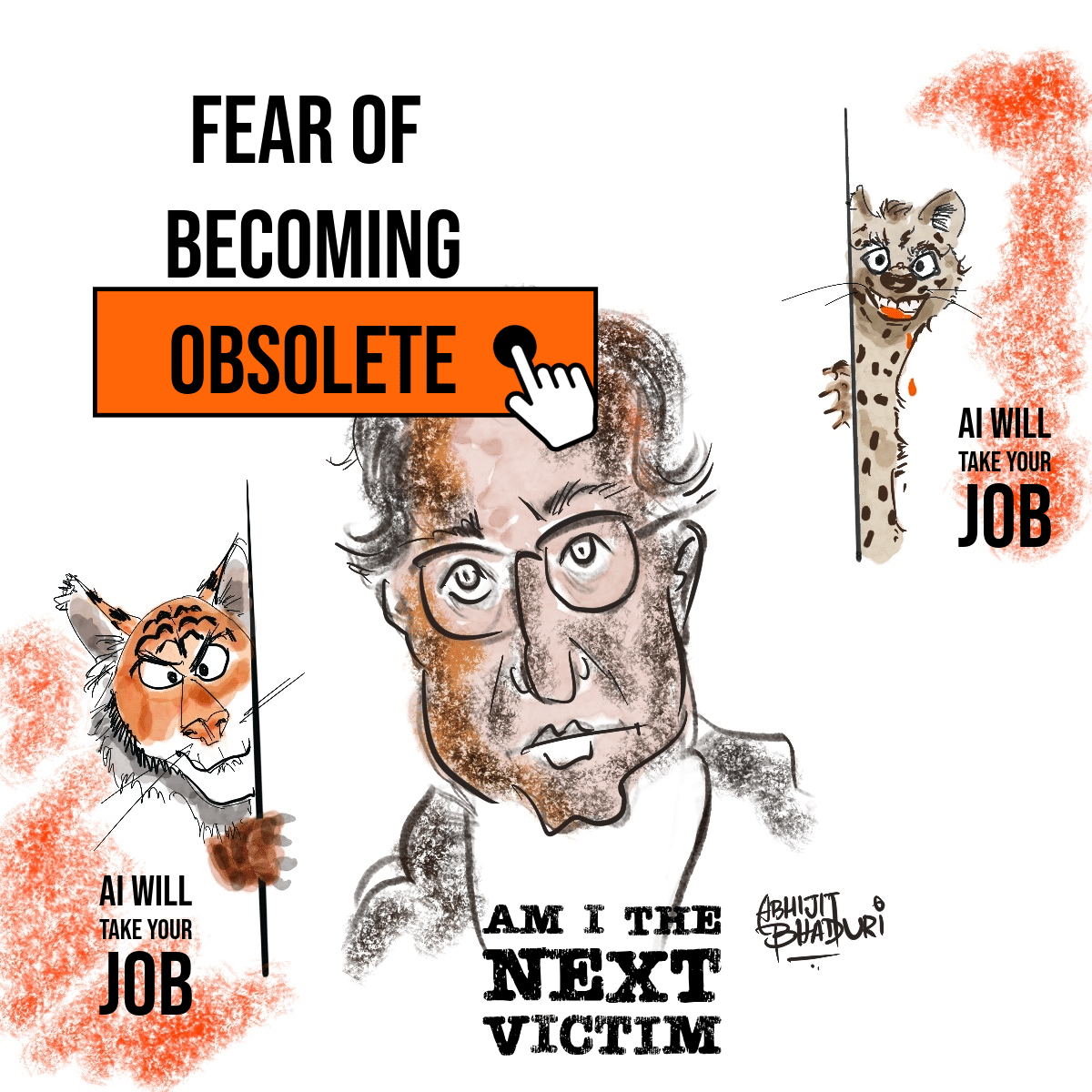
Two ideas, grounded in the image’s core anxiety — “Am I the next victim?”
1. Replace the Performance Review with a “Relevance Review”
Most talent systems measure how well someone did their current job. That’s backwards in an AI economy — because the job itself may be disappearing.
Instead, design a quarterly Relevance Conversation with three simple questions:
- What problems are you uniquely solving that AI cannot yet replicate?
- What have you learned in the last 90 days that didn’t exist in your job description?
- Where do you want to be irreplaceable 12 months from now?
This reframes the entire talent system from judging past performance to building future relevance. The employee stops feeling like a victim waiting to be replaced and starts feeling like an architect of their own value. The fear doesn’t disappear — but it gets converted into productive energy.
2. Build an Internal “Skills Marketplace” — not a Job Board
Most orgs move people through fixed roles. When a role disappears, the person feels disposable.
A Skills Marketplace works differently: employees list what they can do, not just what their title is. Leaders post problems they need solved, not job openings. Matching happens around capability, not hierarchy.
The psychological effect is profound — when someone sees their skills being pulled across three different teams, they stop asking “Will AI take my job?” and start asking “Which problem should I work on next?”
Identity shifts from role-holder to problem-solver. That one shift is the antidote to obsolescence anxiety.
The good news is that the change is visible. It is not happening overnight. People can see it coming. They have time to respond.
But time alone does not solve anything. What matters is whether organizations create the conditions for people to move before the water rises too high.
FOBO is rational. But it does not have to define the future. The companies that get this right will not just reduce fear. They will unlock a very different kind of talent.