
 Learning Teams have to create a culture of curiosity. They have to juggle between formal and informal approaches. How can they choose?
Learning teams don’t need to choose
Informal Learning must supplement the formal approaches the organization’s learning and development (L&D) teams encourage. Formal training is always episodic. The organization can pull out the employees only so many times in a year for a limited amount of time to get them to attend a training program.Employees have to supplement the employer’s training and skill building programs with their own continuous efforts to upskill and reskill themselves.Formal training is like the conducted tour of a city you can take. Informal learning is like the experience of sauntering around a city’s by-lanes exploring, stopping to talk to strangers and sampling what strikes your fancy. L&D teams can do both. They do not have to choose.
4 Ideas for L&D Teams
I recently spoke to Kevin Anselmo, who runs different communications programs for L&D departments. His podcast is about stories from the world of learning. Listen to the podcast <click this> Here are four ideas that emerged:
- Build curiosity: Too many of us stop looking outside our organization’s walls. Does your L&D team invite people from outside to work with them to bring an outside in perspective to the organization – especially its leaders and their teams. Study competitors. Study what people in other sectors are doing to solve their problems. Some of them can be applied to your organization too.
- Storytelling: Making sure people have learned used to be the holy grail of the L&D teams. It is time to revisit that premise. Can the L&D team make the learners become storytellers? The domain experts of your organization must be expert storytellers. They will be the best evangelists to upskill the rest of the organization.
- Employee engagement: Birthday parties do not drive engagement. Those are temporary blips that are forgotten by the time employees have gone home for the day. Can the L&D team drive engagement by helping people build expertise? Maybe it is time to have L&D teams run employee engagement programs. Helping employees to get better at their work matters.
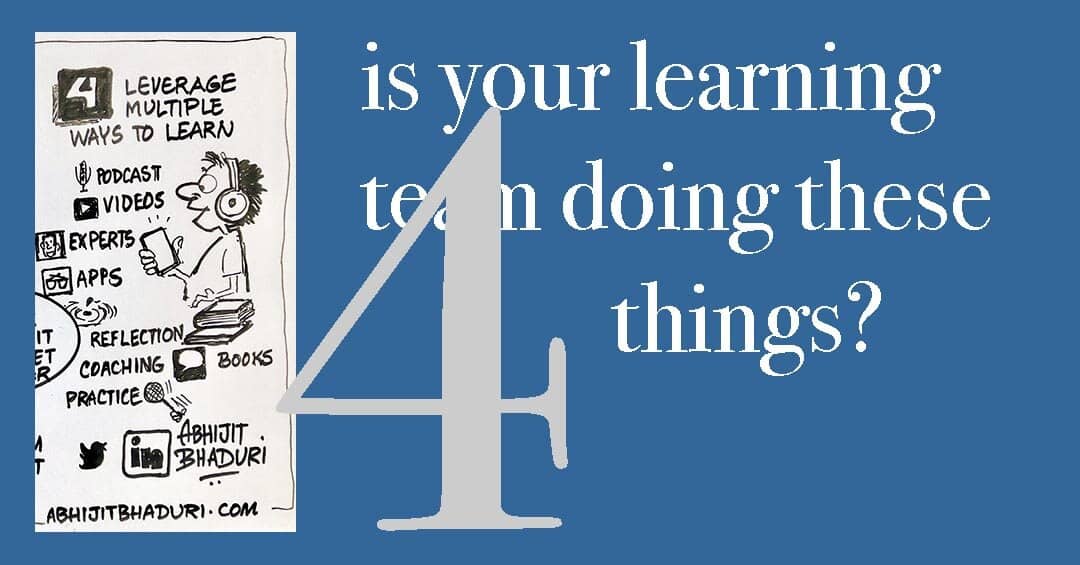
- Everywhere learning: Just being aware of the multiple options we have to learn is empowering. Podcasts, videos, apps, connecting with experts, books, getting a coach are some of the most powerful ways in which people learn.
 Which of these four approaches has your L&D team taken to move from episodic formal training programs to building a culture of learning?——–=========——–Join more than 700,000 people who follow me on LinkedIn & Twitter @AbhijitBhaduriWant to invite me to your organization for a workshop for your teams? Or to work to upskill the HR team or deliver a keynote address? Drop me a mail at abhijitbhaduri@live.com
1 Comment
[…] You probably use one or more of these open source learning systems: TED talks, General Assembly, EdX, Big Think … and then you have many formats of content – videos, podcasts, blogs, websites, newsletters. I use a number of whitepapers and reports published by various organizations. Your employer probably has their own LMS to share content. Having great content does not ensure learning.Read: Is your learning team doing these 4 things? […]