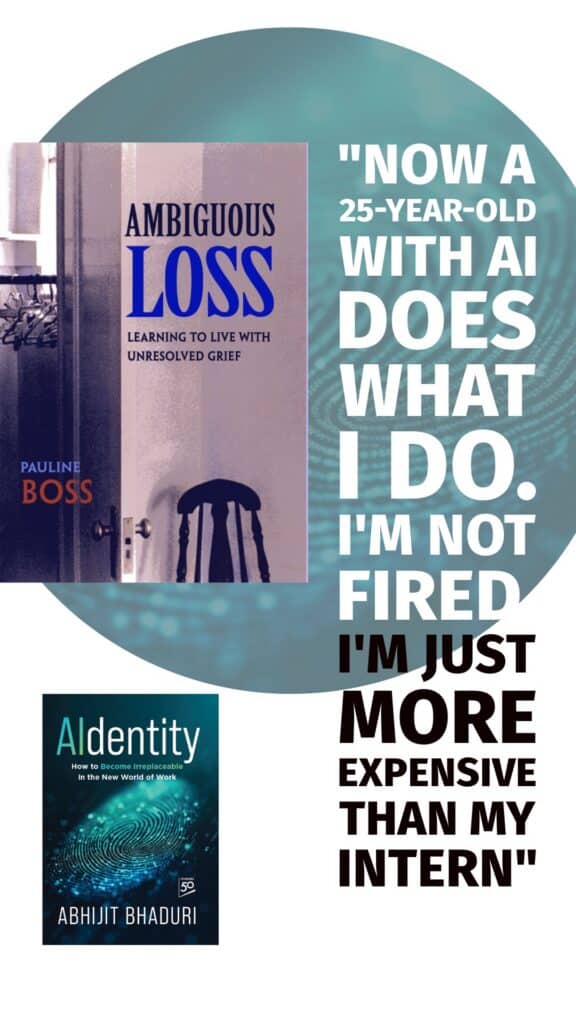
There’s a kind of loss that we cannot name. There is no funeral, no goodbye or farewell. And you’re mourning something anyway. Without naming the loss, we cannot grieve and find closure.

Psychologist Pauline Boss spent five decades studying loss before she gave this feeling a name: ambiguous loss. She talked about two kinds of loss, and both are showing up across the workforce right now. Her book, Ambiguous Loss: Learning to Live with Unresolved Grief, is the best text on the subject.
Loss leads to grief. But with ambiguous loss, the ability to grieve is frozen. You are stuck, waiting for clarity that may never come. Mourning our loss allows us closure that is necessary to move on. Loss can come in two forms:
A goodbye without leaving
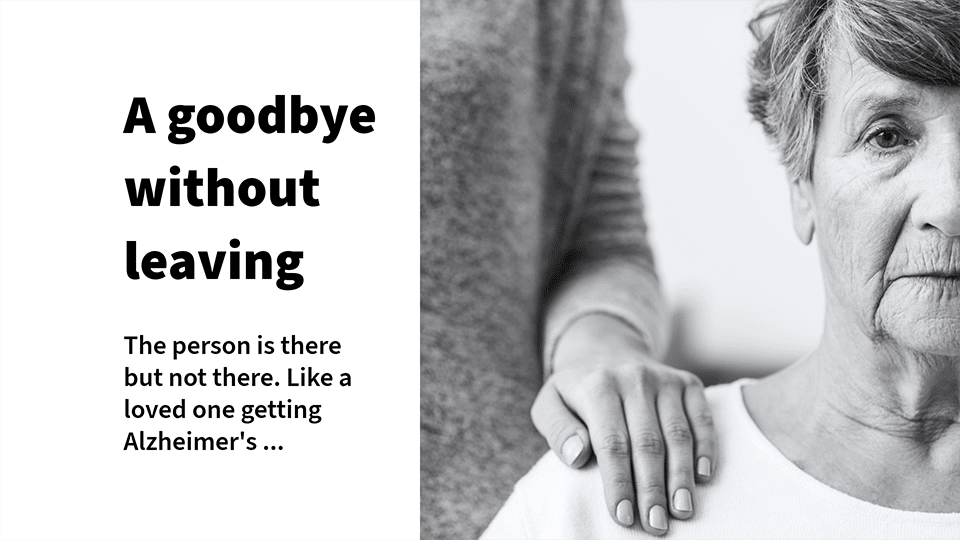
A “goodbye without leaving” is what happens when the identity you are grieving is still physically present but emotionally or relationally gone.
A family member having Alzheimer’s disease is perhaps the single most powerful illustration of “a goodbye without leaving.” The person is physically there. You can hold their hand, hear their voice, but the person you knew, the shared history, the mutual recognition, has quietly slipped away. You are grieving someone who is still breathing beside you. This is a long, cruel goodbye.
Leaving without a goodbye

Something disappears under circumstances that offer no ceremony, no farewell, no naming of what was lost. A soldier missing in action is an example of this. There is no body, no funeral, no last letter, no final moment to hold on to. The absence is total, but so is the ambiguity. You don’t know whether to mourn or to hope, and that unresolved space is precisely what makes the loss so hard to metabolize. The goodbye was stolen before it could happen.
AI is triggering both kinds of losses
I write about both of these at length in my upcoming book, AIdentity, because what I kept hearing from people wasn’t that they lost their job or that AI took away their identity that had been built over years.
The person who embodies both shapes at once is Denise, a senior systems engineer with thirty years of expertise, whom I interviewed while researching my book AIdentity. Her title hadn’t moved. Her desk was still hers. But her company had quietly started asking whether a junior with AI tools could do close to what she does, for a fraction of the cost. Her own words stayed with me longer than almost anything else I heard:
“I’m not fired. But I’m also not needed the same way. My experience used to mean something. Now it just means I’m more expensive than my intern.”
That’s not a career transition. That’s unprocessed grief of a loss she cannot find a name for.
We have seen how in the AI era, millions of professionals are experiencing a longing for the version of their work that once gave them meaning, that still lives in their memory, but that the world has moved on from. The layoff happened abruptly.
And we have also seen how you do not need to leave your job, or be laid off from it, to sense becoming professionally irrelevant. You cannot mourn because you are still employed. You cannot authentically celebrate because the career you spent decades building is no longer something you fully recognize. Feeling irrelevant is ambiguous loss.
It is uniquely painful because there is none of the clear closure that mourning a deceased loved one provides. Mourning allows us to move forward. Ambiguous loss keeps us suspended. We need to find a way to name the loss so that we can grieve and find closure.
Between the two, watching your role get hollowed out while you’re still in the chair, or watching a hard-won role disappear overnight, which one would be harder for you to deal with? What have you noticed? Leave me a comment.