
MicroStimuli by Biju Dominic argues that persuasion happens in milliseconds by non-conscious processes. Offering information and building awareness does not change behavior. Emotions and visuals are more persuasive.
Sixteen people. Every day. On the railway tracks of Mumbai. Hit by trains they can clearly see coming.
Biju Dominic heard this statistic from a senior Indian Railways official in 2007 and could not let it go. How? How does a person look at an approaching train and step onto the tracks anyway? How does awareness fail so completely at the moment it matters most? The Railways had tried every possible option. They had put up signs, had the police patrol the tracks and run awareness campaigns that showed people dying. So why did people still do something that they rationally know to be a killer?
That question is the heart of MicroStimuli a book that captures Biju Dominic’s almost 3 decades of experience of solving tricky problems. How to get people in a Gulf country to start walking more. To stop human trafficking…

The core thesis in three sentences
99.99% of human decisions are made by non-conscious processes that are faster, larger, and more powerful than conscious thought.
Every system we have built to change human behaviour from advertising to education, management, public policy and religion is aimed at the conscious 0.01%.
MicroStimuli are precisely designed triggers, delivered at the exact moment of decision, that speak directly to the non-conscious brain in the only language it processes at full speed: emotion, evolutionary instinct, and context.
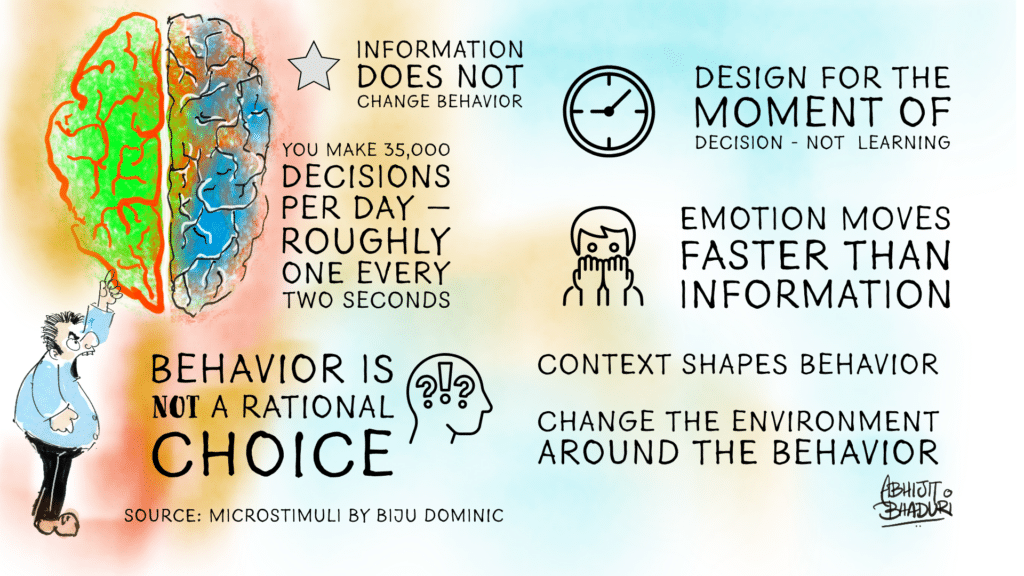
We have designed most corporate communication and HR processes with the assumption that human decision making is a rational process. It is NOT.
Awareness does not change behavior because most of us believe that if we have information, we will take the right action. 99.99999 % of the brain is dedicated to processing unconscious signals. To change behavior, change the context and appeal to the emotions at the time of decision making.
Decisions shouldn’t be guided by emotions… really?
Let me tell you the story of Phineas Gage. Phineas was a railroad worker who survived an iron rod blasting through his frontal lobe in 1848. Before the accident, he was responsible and well-liked; afterward, he became impulsive, profane, and couldn’t hold plans or relationships. His case showed us that emotions aren’t separate from rational thinking, they’re essential to it. The damage to his emotional processing centers didn’t just change his feelings; it destroyed his ability to make good decisions, keep jobs, or function in society. Gage proved that without emotional circuitry intact, human reasoning collapses—emotion is the scaffolding that holds rational thought together.
Yet, the business world treats emotions to be inferior to logic. The higher up in the hierarchy must progressively show less emotion and more logic.
But the most powerful insight of the book Microstimuli lies in understanding how context changes our behavior. When we miss the context, our behavior is out of line.
Biju creates a 2×2 matrix of Behavior and Space. There is individual behavior and group behavior. The behavior can be in a private space or a public space. That looks like this:
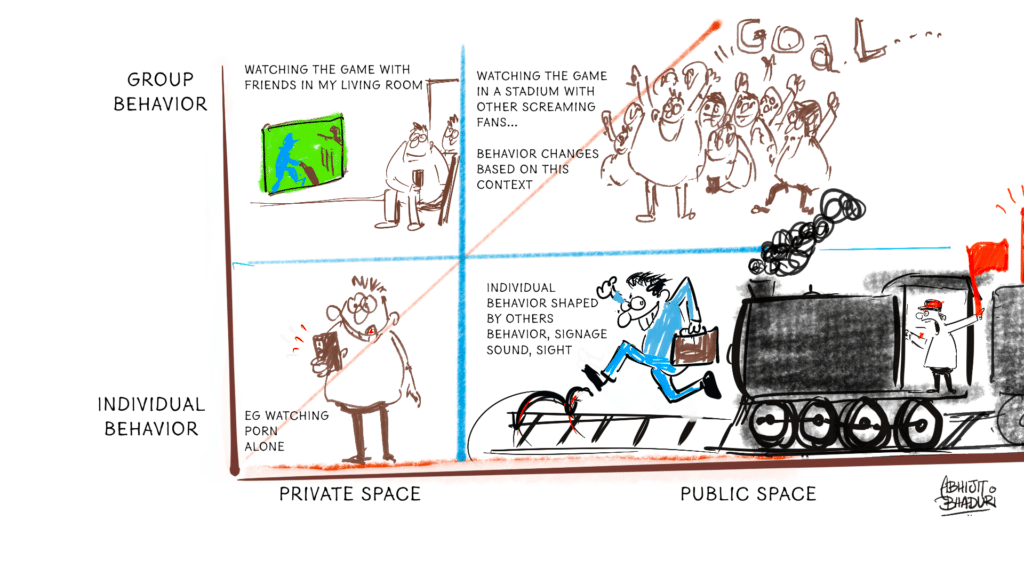
People behave differently when they watch the same game in their room with friends. When the same person is with others in a stadium to watch the same game they behave differently. To the question why people cross the railway track KNOWING that a train is approaching must be seen in the context of where the behavior is occurring. Biju and his team created micro stimuli. The train horn was made staccato – instead of a long continuous horn. There were photos of people about to be hit by the train (not photos of people dying, because no one has seen themselves dead!) and the railway tracks were painted in strips of yellow to show speed of the approaching train.
Persuasion through Microstimuli
MicroStimuli is a rare thing: a book built on genuine original fieldwork, grounded in rigorous neuroscience, and tested against some of the hardest behaviour change problems in the world. It is the work of a practitioner who spent twenty-eight years asking “why doesn’t this work?” before asking “what would?”
The answer he arrived at — that human behavior is driven by non-conscious processes operating in milliseconds, and that effective persuasion must speak to those processes directly, at the moment of decision, in the language of emotion and evolutionary instinct is not new in its individual components. Kahneman said something similar with System 1 and System 2. Thaler and Sunstein said something similar.
What Dominic adds is the operational framework: a step-by-step architecture for building a MicroStimuli, grounded in cases where it demonstrably saved lives, prevented corruption, and moved sedentary people to walk, not by telling them what to do, but by speaking, in milliseconds, to the deepest parts of the brain that have always known what matters.
So how to write effective love letters? Use the same three principles!