
In the AI era, the people who freely share knowledge and have great judgement and what they teach others to do, will define the most valuable employees.
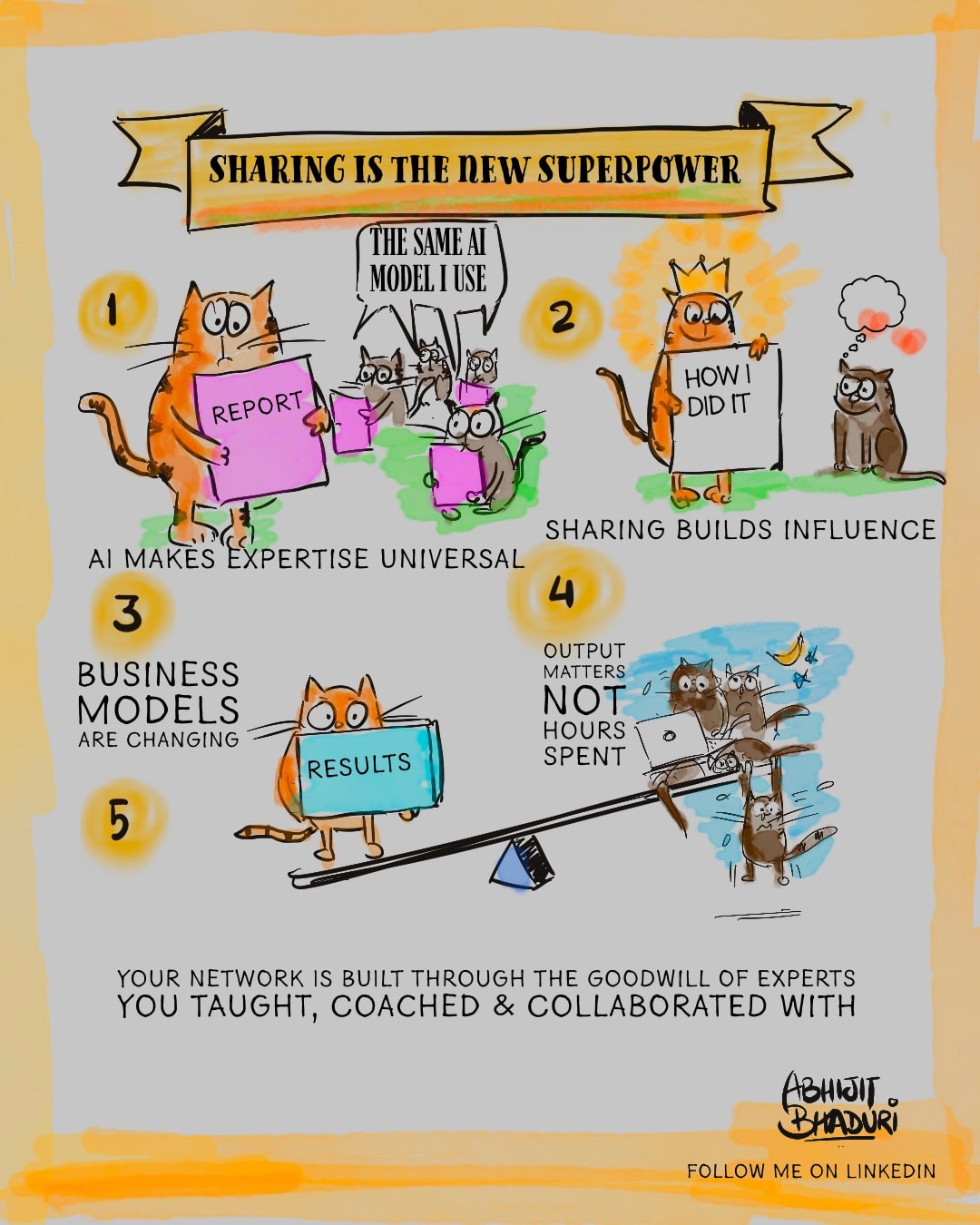
Information was power – now it is all about the judgement and interpretation of the information that is at a premium. Hoarding knowledge made someone powerful in the industrial era. Today it is the opposite that we look for in our colleagues. Power comes to those who share. Those who share their expertise freely are the ones who are sought after.
- AI democratizes knowledge
Traditionally, expertise created power because information was scarce. Teams, departments, and individuals built influence by controlling access to knowledge. AI makes expertise instantly accessible across the organization, weakening those information monopolies. So sharing is what gives you power. - Organizations become flatter
If everyone has access to the same information through AI, decision-making becomes less dependent on hierarchy. Influence shifts from “I know something you don’t” to “I help everyone make better decisions.” - Output will be paid for – not billable hours
If everyone has the same information, the one who can use that information to achieve results becomes more valuable. Businesses built on billing for labor hours will have to rethink their business models. - The business model will change
Take for example advertising. AI reduces the cost and time required to produce advertising. Agencies can no longer justify charging clients based on large teams and lengthy production cycles. Competitive advantage will come from strategy, creativity, and outcomes rather than labor intensity.
For HR and talent leaders, the article has broader implications than marketing alone.
- Expertise is becoming less scarce than judgment.
- Knowledge hoarding becomes a liability instead of a source of power.
- Internal collaboration becomes a measurable competitive advantage.
- Organizations should reward people who build systems, teach others, and create reusable knowledge rather than simply accumulate expertise.
- Performance management may need to shift from “What do you know?” toward “How much capability do you create in others?”
One useful way to think about it is this:
| Before AI | After AI |
|---|---|
| Information creates power | Interpretation creates power |
| Expertise is scarce | Judgment is scarce |
| Hoarding knowledge increases status | Sharing knowledge increases status |
| Managers control information | Leaders enable learning |
| Individual productivity matters | Collective intelligence matters |
The deeper insight is not about technology. It is about incentives. Organizations have historically rewarded people for becoming indispensable. AI makes raw knowledge increasingly abundant, so the scarce resource becomes trust, judgment, context, and the ability to elevate the performance of others. Those who build networks of capability rather than personal empires are likely to have the greatest influence.