

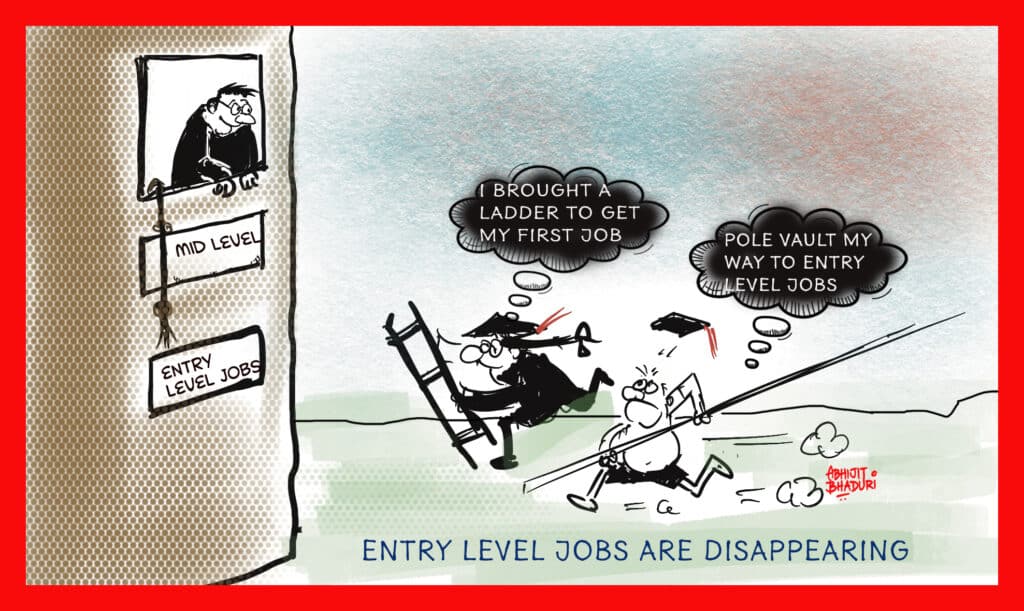
AI has occupied the first floor of the building
Across industries and continents, the first floor of careers is quietly disappearing. For decades, entry-level jobs were the first step on the ladder to success. They offered on-the-job learning, mentoring, and space to make beginner mistakes. But today, that bottom rung is eroding fast—especially in office jobs.
Why? Because AI is automating the foundation layer of work.
Junior coders once learned by debugging—now AI writes and fixes code.
Paralegals reviewed documents—AI now does it in hours.
Retail associates answered questions—chatbots do it instantly, 24/7.
This isn’t just a tech-sector story. From fast food in the U.S. to banking in India to finance in Europe, early-career tasks are being handed over to automation.
Let’s understand this shift through the Skills Pyramid
- At the base: Routine, rule-based work (most vulnerable to AI)
- In the middle: Collaboration, pattern recognition, communication
- At the top: Creativity, empathy, problem-solving, leadership
AI excels at the bottom. That’s why entry-level roles—once the training ground—are being commoditized. The tasks still exist, but they’re increasingly done by machines.
What does it mean for GenZ
Not despair. Just a different route forward.
Here’s how Gen Z can adapt and thrive:
1. Stop thinking of the “first job” as task-based. Think learning-based.
Choose roles that stretch you, not just keep you busy.
2. Move up the skills pyramid early.
Learn to frame problems, communicate ideas, and collaborate across teams. These are skills AI can’t replicate.
3. Use AI as a co-pilot, not a crutch.
Speed up the basics with AI, then focus on quality, judgment, and improvement. That’s what firms like KPMG and Macfarlanes are doing with their early-career hires.
4. Build a portfolio, not just a résumé.
Projects. Certifications. Side hustles. These matter more than job titles when everyone’s career is non-linear.
5. Trade pay for growth if needed.
A small salary cut today for a bigger learning curve tomorrow is a smart investment. 40% of Gen Z says they’re already willing to do this.
6. Seek roles that teach adaptability—not repetition.
Today’s world of work rewards agility. Don’t aim to be irreplaceable at the bottom—aim to be versatile at the top.
The first job hasn’t vanished. It’s just been redefined.
And those who treat it not as a step but as a springboard will rise faster than ever before.
Let’s help Gen Z see opportunity—not scarcity—in this transformation.
Would love to hear your thoughts. How are you redesigning early-career roles in your organization?
