
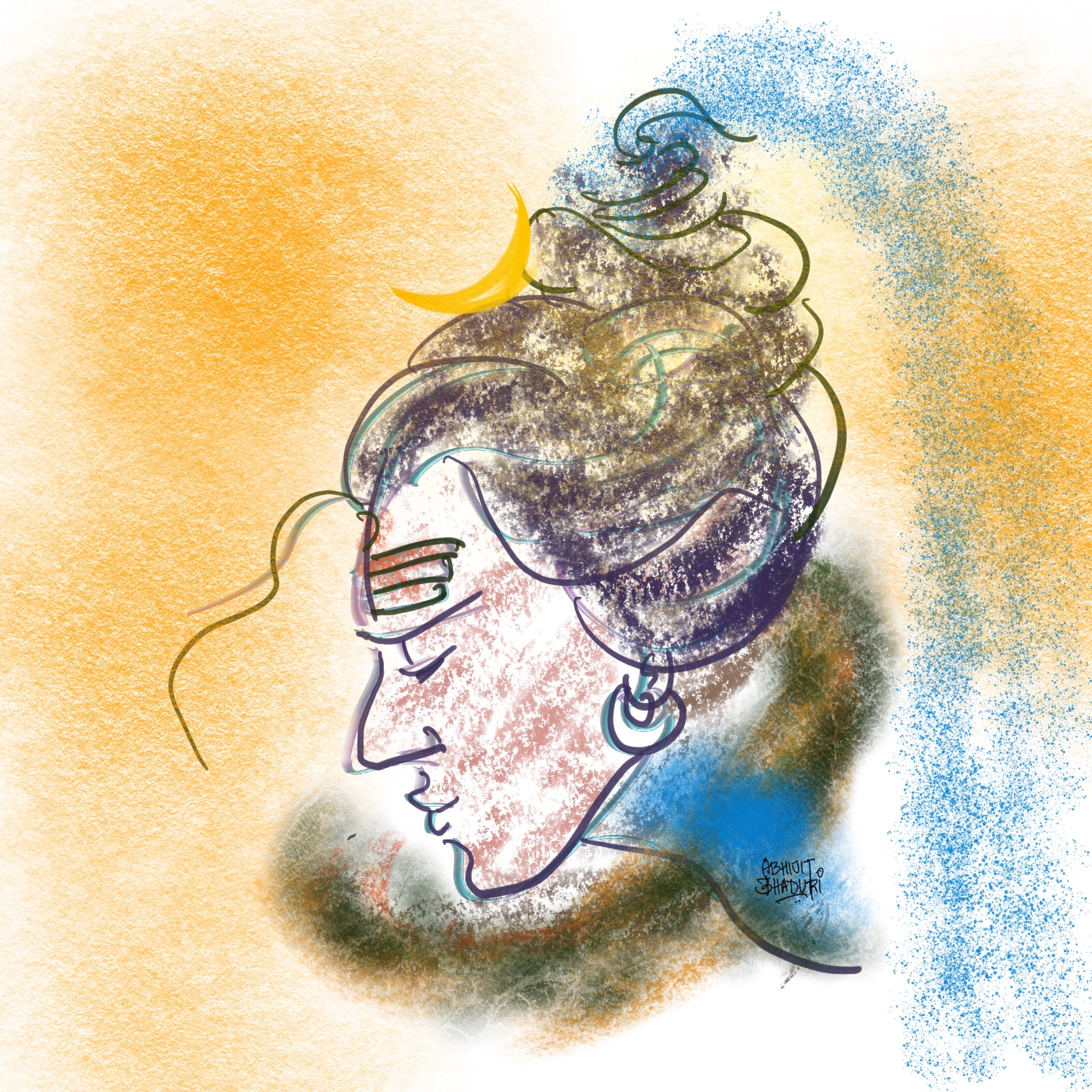
The Morning Ragas all evoke different moods in the listener. They evoke different images as we listen to them. For instance, Raga Lalit is a Raga that you wake up to.
But Raga Bhatiyar is a raga you listen to as you are still in bed, in that half asleep state when you are still in two minds whether to get out of bed or to just roll over and back to sleep. <learn more>
You will notice in the Raga Samay Chakra (trans: The Wheel of Time) the Ragas enhance the mood of the listener of sung at the right time. Raga Bhairav (which is distinct from Raga Bhairavi) is the Raga that has the picture of a stern patriarch inviting you to get out of bed and join him in prayer. Raga Bhairav is a raga associated with Lord Shiva. Some musicians also call it Raga Bhairo or Bhairon.
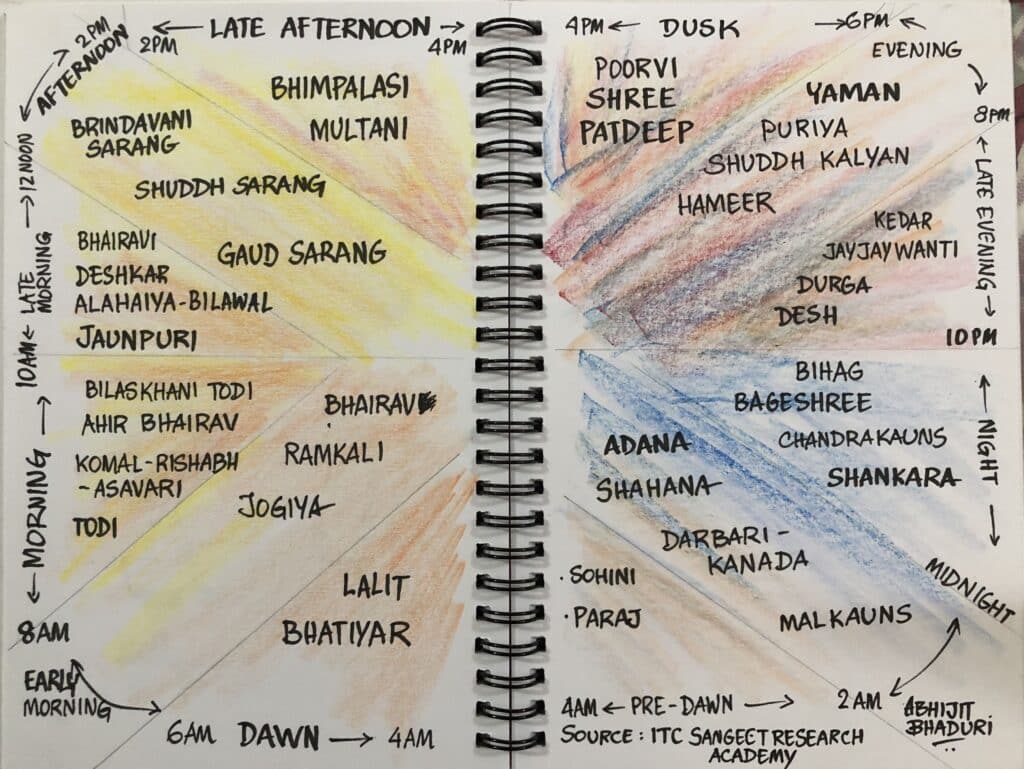
Bhairav is considered to be an incarnation (Avatar) of Lord Shiva who is fierce and associated with destruction. It is believed that Bhairon is connected to the Southern face and relates to the Mahavidya goddess named Bhairavi. The Sinhalese worship the same God as Bahirawa who is the God of treasures.Bhairav is considered a masculine Raga and its consort is Raga Bhairavi (another melodious late morning Raga). Bhairav Raga is based on the family (or Thaat) also called Bhairav. Bhairav Thaat has other morning ragas too such as Ramkali and Jogiya.
You will notice that Ramkali and Jogia are also bunched with Bhairav to be sung at the same time.
My favorite example of Raga Bhairav being used in Hindi film music is the song Jago Mohan Pyare composed for the Raj Kapoor-Nargis starrer Jagte Raho (1956). It captures the devotional mood of the raga where the devotee is asking the Lord to wake up from sleep and acknowledge the devotee. The music composer is Salil Chowdhury.
I was in Varanasi recently. If you take a walk along the ghats in the morning, don’t miss the live classical music played by maestros. Old timers will tell you about Raga Bhairav on the shehnai played by Ustad Bismillah Khan that woke the city up.

The other brilliant example of a film composition based on Raga Bhairav is from Baiju Bawra (1952), the story of a wandering minstrel Baiju. This film has music composed by Naushad and has some lovely compositions – all of which are based on different Ragas. The song Mohe Bhool Gaye Saanwariya (Trans: You have forgotten me Krishna…) sung by Lata Mangeshkar.
My friends will all tell you that while no one can fault Lata Mangeshkar’s skill as a singer, I have always considered her sister Asha Bhosle to be a slightly better singer. Lata Mangeshkar’s perfection appeals to the purists. It appeals to logic. Asha Bhosle’s singing has a certain soul and emotion in it that connects deeply with me. Let me know what you think?
Kaushiki Chakrabarty (Patiala gharana) sings this beautiful version of Raga Bhairav. The Patiala Gharana is also known for its strong emphasis on rhythm. This is reflected in the use of rhythmic variations and improvisations, as well as the precise execution of talas (rhythmic cycles). In Bhairav, the Patiala Gharana’s rhythmic approach adds a dynamic element to the raga’s otherwise tranquil flow.
Read my post about Waking Up to Raga Lalit
14 Comments
Enjoyed Pt. Jasraj thoroughly. Was nice to see Pt. Bhimsen in the audience – a bit Hitchcockian 🙂
That is a new and interesting topic. Who is the author of this piece can I upload on esamskriti.com.
Hi.. can you please clarify,, please see above article.. Sorry, but you say the song Dekho bijili dole from Phir wohi dil laya hoon is in Raga Bhairav…. but you have included this song in the article on Raga Ramkali too as an example..can you please clarify.. my mail id is amirapu2001@yahoo.co.in..thanks.
Hi , thanks for your articles.. can you please advise the time of playing the following ragas..Charukesi. Nat Bhairav,Desi, Gunkali,Gaud Malhar ,(other than rainy season ) Gara and Vibhas.
Very informative
I can provide you with a few songs if you wish
Thanks, very informative..
Pandit Jasraj was mesmerising ! thank you for sharing
Nice bllog you have
You should update your website
Thanks Satyajit. I just converted it from Squarespace to WordPress and the formatting has gone haywire. Thanks for nudging me to fix this post for starters.
Most welcome @AbhijitBhaduri, however I am Satyajay, not Satyajit, even the display name shown in the comment I made is also Satyajay
So sorry Satyajay for getting your name wrong. I can’t even blame it on Autocorrect! I am fully responsible.
Thanks a kilogram @AbhijitBhaduri